Insights · Article · Cloud · Apr 2026
Connecting platform satisfaction surveys to delivery outcomes, reliability, and financial narratives CFOs recognize.

Internal developer experience programs lose executive funding the moment they sound like optional quality-of-life perks for engineers. They secure sustained investment when tied directly to revenue protection, security compliance acceleration, and reduced attrition among senior technical staff. Business leaders need key performance indicators that bridge the gap between subjective developer sentiment and financial outcomes. Without that bridge, even well-designed platform initiatives remain vulnerable to the next round of budget cuts.
The core challenge is one of translation. Engineering leaders speak in deployment frequencies, build times, and incident counts. Finance executives speak in margins, cost avoidance, and risk mitigation. A credible developer experience program must produce metrics that function in both languages simultaneously. This means selecting indicators that carry genuine operational meaning for platform teams while also mapping cleanly to the financial narratives that CFOs present to boards and audit committees each quarter.
Standard DORA metrics, including lead time for code changes, change failure rate, deployment frequency, and mean time to recovery, remain foundational. These four indicators have decades of empirical research behind them and correlate strongly with organizational performance. However, they are necessary but not sufficient on their own. Executives who see only DORA numbers may struggle to connect them to specific platform investments, so a second layer of platform-specific measures must sit alongside them.
That second layer should include the total time required to provision a fully compliant, secure development environment, the percentage of services running on standardized golden paths, and the automated security testing coverage executed against deployment templates. These metrics directly reflect the health and adoption of your internal platform. When golden path adoption climbs from forty percent to eighty percent, you can draw a direct line to reduced incident rates and faster onboarding for new engineers.

We facilitate small-group sessions for customers and prospects without requiring a slide deck, focused on your stack, constraints, and the decisions you need to make next.
Qualitative surveys matter deeply, but only when administered consistently and segmented by cohort tenure and product team. A tightly scoped quarterly cadence produces far more actionable data than an annual survey that generates a mountain of unstructured complaints. Keep the instrument short, ten to fifteen questions maximum, and rotate open-ended prompts each cycle so respondents stay engaged. Leadership must visibly act on the highest-priority themes; otherwise engineering skepticism compounds rapidly with every survey round.
Publishing survey results alone is not enough. Dedicate a standing agenda slot in your platform team's sprint review to address the top three pain points engineers raised. Assign ownership, set target dates, and report progress in the following quarter's survey communication. This closed-loop pattern transforms the survey from a complaint box into a governance mechanism. Engineers who see their feedback driving real changes become your strongest internal advocates for continued platform investment.
Tracking engineering toil hours per sprint makes invisible maintenance work visible to leadership. If legacy platform gaps force teams through manual ticket workflows for environment provisioning, database access, or certificate rotation, quantify that wasted duration precisely. Express the cost in terms finance teams understand: hours reclaimed per quarter, equivalent headcount freed, and the opportunity cost of delayed feature delivery. Operational friction becomes a budget line item rather than an abstract complaint when reported this way.
Set explicit toil reduction targets tied to platform releases. If your new self-service database provisioning tool is projected to eliminate eight hours of manual ticketing per team per sprint, track actual hours saved after launch. Report the delta between projected and realized savings honestly. This discipline forces candid assessment of platform impact and builds a track record that makes future investment requests far more credible with finance committees reviewing annual capital allocation.
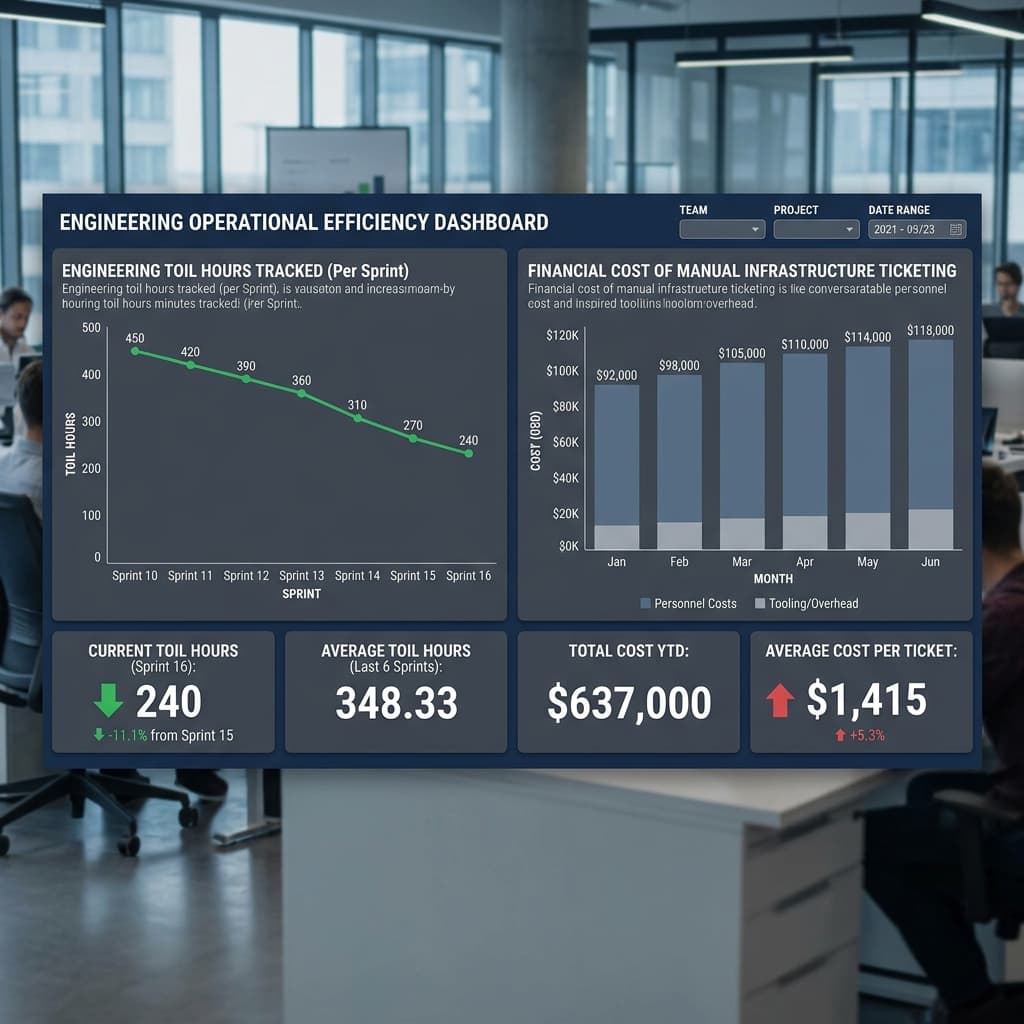
Reliability correlations strengthen the business case significantly. Teams running on modernized deployment platforms should demonstrate fewer customer-impacting incidents per deployment cycle compared to teams on legacy paths. Segment your incident data by platform adoption tier and present the comparison transparently. If the data does not yet show improvement, that is a signal to investigate root causes rather than cherry-pick favorable numbers. Honest data builds lasting credibility; curated anecdotes erode it quickly.
Take the reliability analysis one step further by modeling the financial cost of incidents. Multiply average incident duration by the revenue at risk per minute of downtime, then compare totals across platform tiers. Even conservative estimates tend to produce compelling numbers. A platform that prevents two major incidents per quarter can justify its entire annual operating cost through avoided revenue loss alone. That narrative resonates deeply in boardrooms where reliability was previously treated as an abstract engineering concern.
Avoid vanity metrics that reward volume over value. Measuring and rewarding total code commits per developer incentivizes noise, not quality. Lines of code, pull request counts, and story points completed suffer from the same fundamental flaw: they measure activity rather than outcomes. Prefer holistic indicators linked to verified customer value, sustainable engineering pace, and system health. Metrics that can be gamed will be gamed, so design your measurement framework to resist manipulation from the start.
Consider constructing a composite developer productivity score that blends objective and subjective signals. Weight factors such as cycle time from commit to production, percentage of deployments requiring rollback, self-reported developer satisfaction, and time spent on unplanned work. No single metric tells the full story, but a weighted composite gives executives a single directional indicator while preserving the nuance that engineering leaders need for operational decisions and sprint-level prioritization.
Funding presentations to financial oversight committees should follow a clean narrative arc. Start with the present state of technical friction, quantified in hours and dollars. Describe the specific investments made during the reporting period. Follow with the measurable improvements those investments produced, expressed in the same units as the starting baseline. Close with the next set of targeted bets and their projected returns. Consistency in this structure builds institutional memory and trust across funding cycles.
Resist the temptation to overload slides with every available metric. Choose three to five headline indicators per quarter and tell a coherent story around them. Supplement with an appendix for stakeholders who want deeper detail. Executives remember narratives, not spreadsheets. If your platform reduced environment provisioning time from three days to fifteen minutes, lead with that transformation story and let the supporting data reinforce it rather than burying it in a table.
Benchmarking against industry peers adds external credibility to internal metrics. Organizations such as DORA, the Platform Engineering community, and analyst firms publish annual benchmarks for deployment frequency, lead time, and developer satisfaction. Position your program's metrics against these external baselines to demonstrate whether you are leading, tracking, or lagging your industry cohort. External benchmarks also help calibrate ambitious but realistic improvement targets for the next funding cycle.
Align your platform KPIs with external product roadmaps to reinforce strategic relevance. Platform work that unblocks a flagship application launch deserves explicit credit during quarterly business reviews. Tag platform milestones to the product initiatives they enable and present them together. This framing shifts the perception of platform engineering from a cost center to a force multiplier. When a product leader credits the platform team for accelerating delivery, that endorsement carries more weight than any dashboard.
Developer experience measurement matures over time. Early-stage programs should focus on a small set of high-signal metrics and expand gradually as data quality improves. Avoid the trap of measuring everything from day one; the overhead of instrumentation and reporting can consume the very engineering capacity you are trying to free. Start lean, prove value with a handful of credible indicators, then invest in richer telemetry as executive confidence and platform adoption grow together.
The most successful developer experience programs treat measurement as a product, not a project. They iterate on their metrics framework with the same rigor they apply to platform capabilities. They deprecate indicators that no longer drive decisions and introduce new ones as organizational priorities shift. When your KPI framework earns the same trust as your financial reporting, your platform program has achieved genuine executive credibility and the budget resilience that comes with it.