Insights · Article · Engineering · Apr 2026
Schema evolution, consumer-driven fixtures, and CI gates that stop breaking topic changes from reaching production Kafka or Pulsar clusters.

Event driven architectures promise loose coupling between services, letting teams ship independently without coordinating every release. In practice, that promise collapses the moment a shared payload schema changes without warning. A producer team that renames a nested field or drops an optional attribute can silently break five downstream consumers before anyone notices. Contract testing exists to close that gap by making schema compatibility a first class concern in every deployment pipeline.
The core challenge is one of distributed ownership. When dozens of microservices publish and subscribe to hundreds of topics, no single team can track every dependency by hand. Spreadsheets and Slack channels fail at scale. Formal contracts, expressed as versioned schemas with explicit compatibility rules, replace tribal knowledge with automation. They shift breakage detection from production incident response to pull request review, where the cost of correction is orders of magnitude lower.
Organizations that delay adopting contract testing often discover its value the hard way. A routine Friday deployment introduces a renamed timestamp field, and by Monday morning the analytics pipeline has ingested hours of malformed records. Recovery demands replaying gigabytes of data, coordinating rollbacks across teams, and filing postmortems. Investing in contract testing up front eliminates this entire category of incident and frees engineering effort for feature work instead of firefighting.
Begin your implementation by deploying a centralized schema registry paired with enforced naming conventions governing Kafka topics, CloudEvents metadata attributes, and dead letter channels. A well structured registry becomes the single source of truth for every payload contract in the organization. Standardized topic nomenclature reduces onboarding friction for new engineers and prevents costly accidental publishes to production topics during local development or staging experiments.
Choose a registry that supports multiple compatibility modes, including backward, forward, and full transitive checks. Confluent Schema Registry and Apicurio both offer these capabilities out of the box. Configure each topic with an explicit compatibility level rather than relying on a global default, because business critical payment events deserve stricter enforcement than low stakes internal logging topics. Document the rationale for each choice in a shared runbook accessible to every producing team.
We facilitate small-group sessions for customers and prospects without requiring a slide deck, focused on your stack, constraints, and the decisions you need to make next.
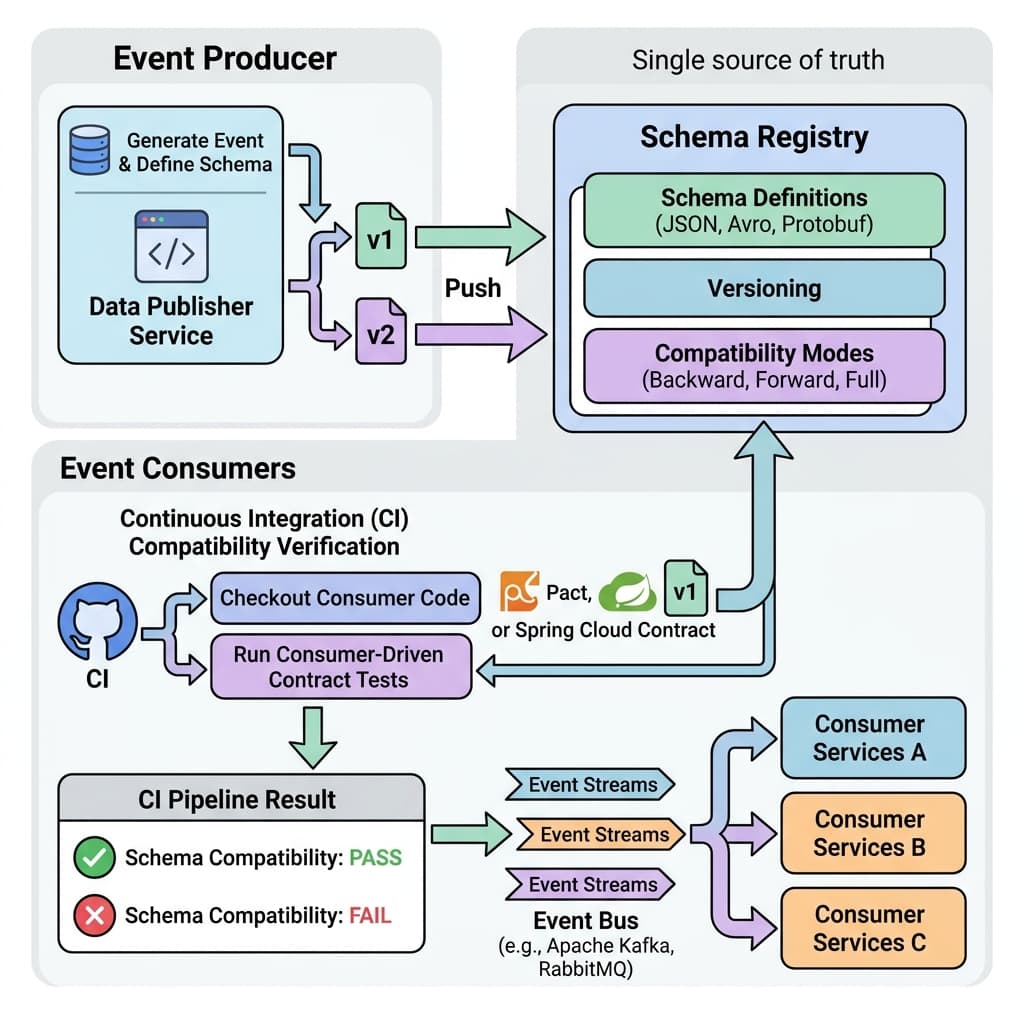
Consumer driven contract testing encodes only the specific payload subset that each receiving service actually requires. Rather than testing against the full producer schema, consumers publish lightweight fixtures describing the fields and types they depend on. Producers then validate proposed changes against the aggregated set of consumer fixtures before merging. This approach eliminates the need for massive end to end integration environments while delivering tighter feedback loops during development.
Implementing consumer driven contracts requires a shared fixture repository or a registry API that consumers push to and producers pull from during continuous integration. Tools like Pact, which originated in the REST API world, now offer messaging plugins for Kafka and similar brokers. Alternatively, teams can build thin wrappers around schema compatibility checkers that accept consumer fixture files and run them as standard test suites within existing CI pipelines.
The fixture authoring process itself drives valuable cross-team conversations. When a consumer declares it depends on a particular nested object, the producing team gains visibility into real downstream usage patterns. This transparency discourages speculative schema design and encourages producers to keep payloads lean. Over time, unused fields surface naturally because no consumer fixture references them, making deprecation decisions straightforward and data driven.
Schema versioning policies should be deliberately boring. Require additive changes first, where new fields carry sensible defaults and existing fields remain untouched. When a field must be removed, mandate an explicit deprecation phase with a published sunset date, giving consumers a migration window measured in sprints rather than days. Reserve truly breaking changes for new topic names, ensuring that no consumer is caught off guard by an incompatible payload on a channel they already subscribe to.
Version numbering conventions reinforce these policies. Semantic versioning works well: increment the patch for documentation fixes, the minor for additive fields, and the major for breaking changes that require a new topic. Embedding the major version in the topic name itself, such as orders.v2, makes incompatibility visible at the infrastructure level. Consumers can migrate at their own pace while both versions coexist, reducing coordination overhead and deployment risk.

Serialization format selection has lasting consequences. Avro offers compact binary encoding with built in schema evolution rules and strong support in the Confluent ecosystem. Protobuf provides strict typing, excellent forward compatibility, and broad language support through generated code. JSON Schema trades compactness for human readability and tooling ubiquity. Each format excels in different contexts, so align your choice with the domain rather than defaulting to a single standard organization wide.
Regardless of which format you choose, avoid mixing serialization standards on the same topic. A topic that accepts both Avro and JSON payloads becomes nearly impossible to validate consistently, and deserialization errors will proliferate across consumers. If a team genuinely needs a different format, route those events to a dedicated topic and document the rationale. Consistency within a topic boundary is the non-negotiable baseline for reliable contract testing.
Observability should extend beyond application metrics to include schema health telemetry. Track compatibility check pass rates, average time between schema versions, and the number of active consumer fixtures per topic. Dead letter queue ingestion rates deserve their own dashboard panel because sudden spikes frequently precede customer visible defects. Correlating schema change timestamps with dead letter volume makes root cause analysis significantly faster during incident triage.
Alerting thresholds for poison message rates should be tuned per topic based on historical baselines. A payments topic that normally sees zero dead letters warrants a hair trigger alert, while a clickstream topic with inherent noise may tolerate a small percentage before escalation. Integrating these alerts with your incident management platform ensures that schema drift issues reach the right on call engineer immediately rather than languishing in a generic monitoring channel.
Security concerns intersect heavily with event streaming when payloads carry personally identifiable information or regulated financial data. Field level encryption, transparent redaction proxies, and topic scoped access control lists should align with your organization's data classification framework. Contract tests can also validate that sensitive fields are encrypted or redacted before they leave the producer, turning compliance requirements into executable assertions rather than audit checklists.
Access control deserves special attention in multi-tenant streaming clusters. Granting broad read access to every topic invites accidental coupling, where a team discovers an internal event stream and builds a dependency without the producer's knowledge. Topic level authorization combined with a formal subscription request process ensures that every consumer relationship is documented and covered by contract tests. This discipline pays dividends when the time comes to deprecate or restructure a topic.
Training engineers in safe schema evolution patterns is the final and arguably most important investment. Automated tooling catches structural incompatibilities, but human judgment determines whether a new optional field needs a logical default, whether a renamed field warrants a migration guide, or whether a payload redesign merits a new topic entirely. Regular lunch and learn sessions, curated internal documentation, and pair reviews of schema change pull requests build this institutional muscle over time.
Mature contract testing transforms event driven architecture from a source of distributed anxiety into a genuine competitive advantage. Teams ship faster because they trust their CI gates. Incidents decline because breaking changes never reach production. Cross-team collaboration improves because contracts make dependencies explicit rather than hidden. Start with a schema registry, layer in consumer driven fixtures, wire both into your pipelines, and iterate from there. The payoff compounds with every new topic you add to the platform.