Insights · Article · Cloud · May 2026
Warehouse credits, slot contention, spilling to remote storage, and prioritization frameworks when every team believes their dashboard is the most important.

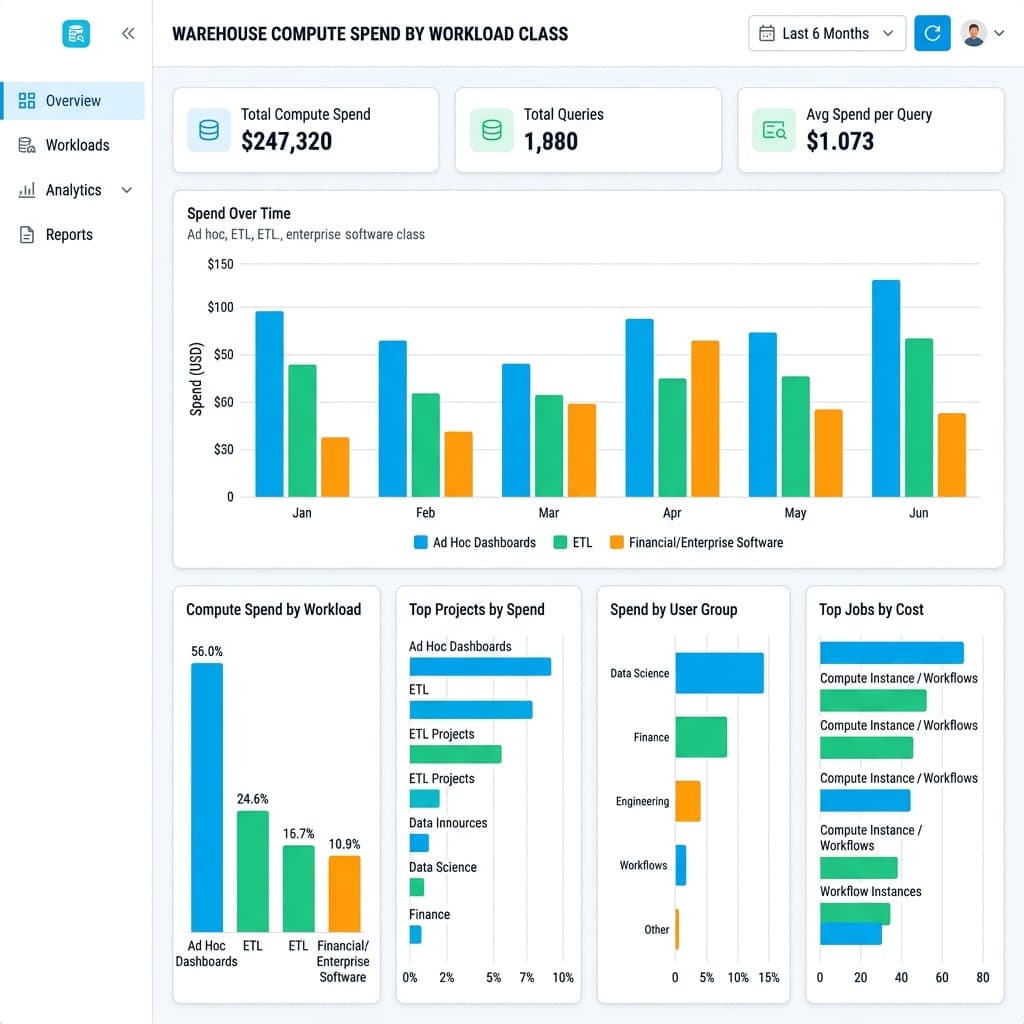
Cloud data warehouses bill strictly on compute time, which means every unoptimized query translates directly into wasted operational budget. Ad hoc exploration, complex business intelligence dashboards, and large batch extraction jobs all compete for the same processing pools. Without deliberate isolation policies and utilization guardrails established by platform engineering leadership, organizations frequently discover that their analytics infrastructure costs have ballooned well beyond initial projections, often by the time quarterly reviews surface the damage.
The challenge compounds when multiple business units share a single warehouse instance without transparent cost attribution. Marketing, finance, product analytics, and data science teams each operate under the assumption that compute resources are essentially unlimited. This perception persists because traditional shared infrastructure models obscure individual consumption patterns. Breaking that illusion requires both technical controls and cultural shifts, starting with visibility into who is running what, when, and at what cost to the wider organization.
Start by classifying workloads into distinct operational tiers: interactive, scheduled, and archival. Interactive dashboard users demand sub-second response times and benefit from dedicated compute nodes sized for their peak concurrency windows. Scheduled transformation jobs can tolerate queuing delays and should target off-peak windows where pricing is lower. Archival queries against historical datasets run infrequently and can leverage the cheapest available compute, provided timeout thresholds prevent runaway resource consumption from accumulating silently.
Each workload tier receives its own financial budget, isolated compute cluster, and timeout policy matched to its business purpose. Platform teams should enforce these boundaries through warehouse-native resource governors or orchestration layers that route queries automatically based on user role, query origin, or estimated scan volume. Hardcoded per-query cost ceilings prevent a single exploratory statement from consuming resources that would otherwise serve dozens of scheduled production pipelines running downstream.
We facilitate small-group sessions for customers and prospects without requiring a slide deck, focused on your stack, constraints, and the decisions you need to make next.
Transparent showback accounting, where each team sees exactly what their queries cost, changes engineering behavior faster than any top-down mandate. When a product analytics group realizes their hourly dashboard refresh consumes more compute credits than the entire finance department uses in a week, they self-correct. Chargeback models that allocate actual cloud invoices back to business units create accountability loops that centralized governance alone cannot replicate at organizational scale.
Implementing effective showback requires tagging infrastructure at the query level, not merely at the cluster level. Warehouse platforms increasingly support query-level labels, user attribution, and session metadata that can be piped into cost analytics dashboards. Pair these labels with automated weekly reports sent directly to team leads so that cost visibility is continuous rather than confined to a monthly review meeting where the numbers are already stale and difficult to act upon.
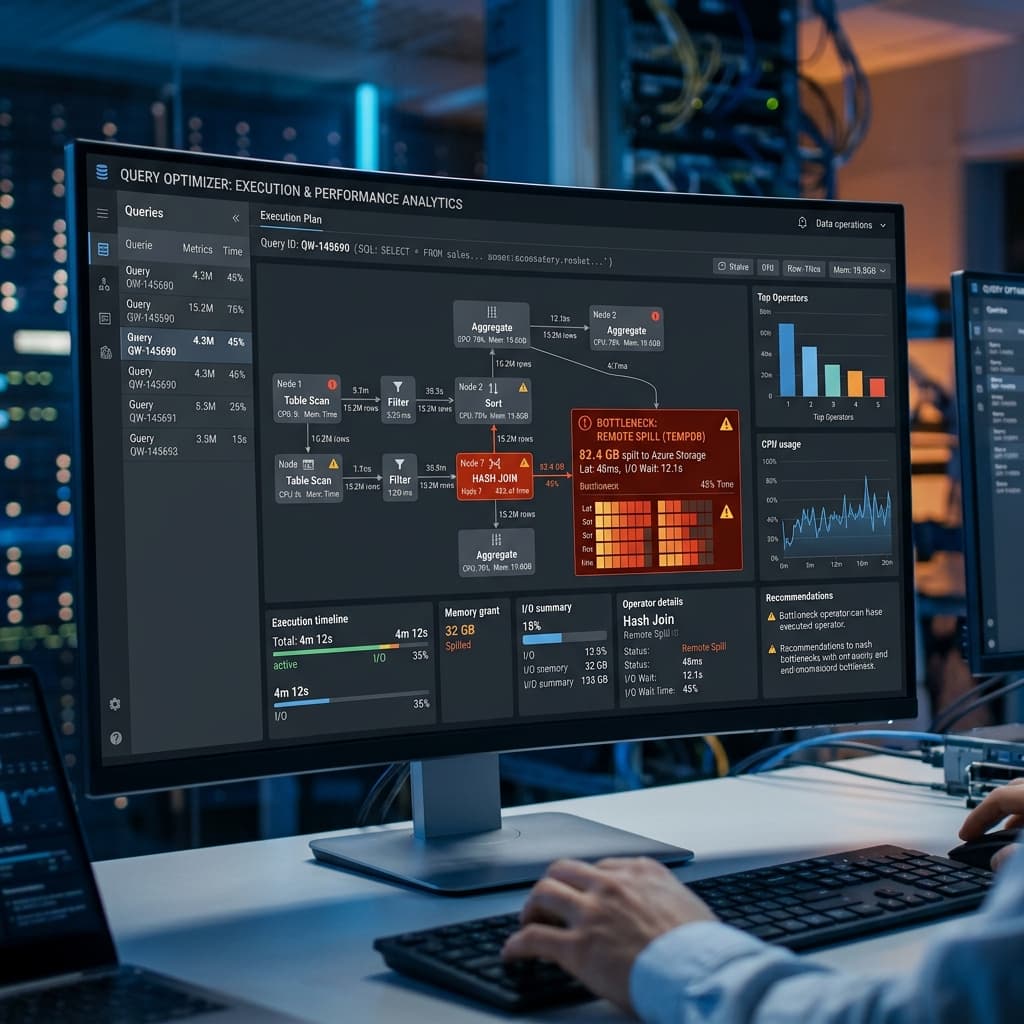
Triaging slow analytical queries begins with raw execution plans that reveal the structural causes of poor performance. Look specifically for remote storage spilling, severe data skew across partitions, and missing or suboptimal clustering keys. When intermediate results exceed available local memory and spill to remote object storage, latency increases by orders of magnitude. Adding more compute nodes will not fix a spill problem because the bottleneck is data movement across the network, not raw processing capacity.
Address data skew by redistributing partition keys to achieve more uniform segment sizes across compute slots. Recluster tables on the columns most frequently used in join predicates and filter clauses, then validate improvements by comparing before-and-after execution plan metrics. Optimizer hints that force specific join strategies or scan orders should remain a last resort. They create brittle dependencies on current data distributions and can silently degrade performance as underlying table statistics drift over subsequent months.
Build a culture of query profiling by embedding execution plan reviews into pull request workflows for any SQL that touches production datasets. Engineers who see the physical cost of their logic, measured in bytes scanned, partitions pruned, and seconds elapsed, make fundamentally different design choices than those who treat the warehouse as a black box. Automated query scoring tools can flag regressions before they reach production, catching issues like unnecessary full table scans or filters applied after expensive join operations.
Materialized views and incremental transformation models dramatically reduce repeated full table scans for popular reporting dimensions. Instead of recomputing aggregations from raw event tables on every dashboard load, a materialized view caches the result and refreshes on a defined schedule. This approach can cut compute costs for high-frequency queries by ninety percent or more, particularly when the underlying source tables contain billions of rows that rarely change within a given reporting window.
However, materialized views introduce freshness obligations that a named engineering team must explicitly own and operate in production. If a view becomes stale due to a failed refresh job or a schema change upstream, the business intelligence layer presents outdated numbers to executives who may make consequential decisions based on that data. Establish alerting on refresh lag, define maximum acceptable staleness per view, and document escalation paths so that failures surface quickly rather than silently compounding.
Strict concurrency limits protect shared warehouse services from catastrophic resource exhaustion. Without explicit queue controls and admission barriers, a single poorly structured query featuring an accidental cross join can starve the compute resources needed for month-end finance close or regulatory reporting deadlines. Admission control policies should define maximum simultaneous queries per user, per role, and per warehouse cluster, with automatic queuing or rejection when thresholds are exceeded during peak demand.
Priority scheduling ensures that business-critical workloads always run ahead of exploratory analysis during contention windows. Assign numeric priority levels to each workload class and configure the warehouse scheduler to preempt lower-priority queries when higher-priority jobs enter the queue. Communicate these priority assignments transparently so that teams understand why their ad hoc query was queued and can plan their analytical work around known high-demand periods like daily reporting refresh cycles.
Semantic layers and unified metric definitions reduce the duplicate business logic that silently multiplies compute consumption across the organization. When five teams independently write five unique queries to calculate the same daily active user metric, the infrastructure pays for that redundancy five times over. A governed semantic layer provides a single canonical definition, compiled once and cached, ensuring consistency across consumers while eliminating the wasted compute that stems from fragmented analytical codebases.
Governing metric definitions requires cross-functional alignment between data engineering, analytics, and business stakeholders. Establish a lightweight review process for new metric proposals that validates naming conventions, calculation logic, and intended refresh cadence before deployment. Version-controlled metric repositories enable audit trails and rollback capabilities when definitions change. Over time, this discipline reduces both compute waste and the organizational confusion that arises when two dashboards display conflicting numbers for what appears to be the same business question.
Financial operations partnerships should regularly translate wasted compute into tangible business equivalents. Presenting warehouse cost overruns as headcount equivalents, delayed feature launches, or deferred infrastructure investments resonates far more effectively with executive audiences than raw credit consumption graphs. A monthly cost review cadence that brings together platform engineering, finance, and business unit leads creates shared ownership of optimization targets and prevents warehouse spend from becoming an unexamined budget line item.
Cultivating cost awareness across the engineering organization requires more than dashboards and alerts. Incorporate warehouse economics into onboarding for new data engineers, include cost impact assessments in design review templates, and celebrate teams that achieve meaningful efficiency gains. When cost optimization is framed as engineering excellence rather than austerity, teams embrace it willingly. Recognition programs that highlight creative approaches to reducing scan volumes or consolidating redundant pipelines reinforce positive habits across the department.
Mandate the scheduled automated deletion of unused tables, obsolete testing sandbox environments, and stale historical snapshots. Storage creep represents quiet budget theft that compounds over quarters, gradually consuming capacity that could fund new analytical initiatives. Implement retention policies that tag tables with last-access timestamps, issue warnings after defined dormancy periods, and archive or drop assets that remain untouched. Pair these policies with a self-service recovery mechanism so that teams feel confident accidental deletions are reversible.
Sustained warehouse performance demands continuous attention rather than periodic firefighting. Combine automated monitoring, workload classification, cost attribution, and governance into a unified platform engineering practice that evolves alongside business needs. Teams that treat query economics as a first-class operational concern, on par with reliability and security, consistently achieve lower per-query costs, faster dashboard response times, and healthier relationships between data producers and data consumers. The warehouse becomes a strategic asset rather than an uncontrolled cost center.