Insights · Article · Data & AI · Apr 2026
Federated governance, domain ownership, and platform funding models that keep data products real instead of becoming another slogan on a slide.

Data mesh promises decentralized ownership paired with centralized standards. In practice, the failure mode is mesh theater: organizations adopt new vocabulary while preserving every bottleneck that slowed them before. Platform teams absorb custom requests they never scoped as products, domain teams wait in the same queues they always did, and executives declare victory because a slide deck now says federated. Avoiding that outcome requires structural changes, not just semantic ones.
The centralized data team model breaks down when an organization scales past a handful of analytical use cases. A single warehouse squad cannot hold context for dozens of business domains, prioritize competing roadmaps, or respond quickly enough to shifting consumer needs. Data mesh addresses this by pushing ownership to the people who understand the data best. However, decentralization without discipline creates fragmentation, so the architecture must balance autonomy with interoperability from day one.
Begin by defining domains along clear business boundaries, not only by database schemas or system namespaces. A domain should map to a capability that a non-technical stakeholder would recognize: pricing, supply chain, customer success, or claims adjudication. Each domain names a product owner for its data, someone accountable for roadmaps, service-level agreements, and consumer feedback loops. Without product thinking, domain datasets become abandoned tables that nobody curates after the initial launch sprint.
Product thinking for data means treating every published dataset the way a software team treats an API. Consumers should find documentation, versioning guarantees, deprecation timelines, and a channel for feature requests. Data product owners hold backlog grooming sessions, review usage telemetry, and deprecate low-value outputs. This discipline prevents the sprawl of unmaintained tables that plagues traditional lake architectures, because every dataset has a named human responsible for its quality.
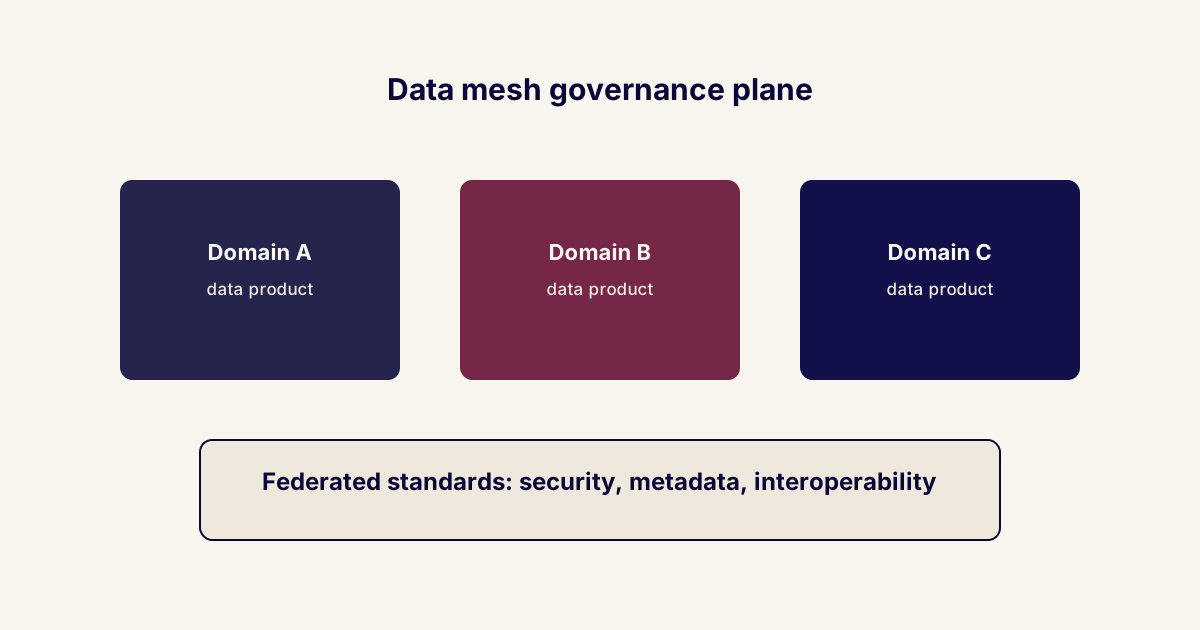
Federated governance needs a thin center of excellence that publishes patterns for security, metadata, interoperability, and observability. This center should remain small, focused on writing golden-path templates rather than reviewing every pull request. It publishes reference architectures, maintains policy-as-code libraries, and trains domain teams to self-certify. When the center becomes a ticket factory that approves or rejects every schema change, it recreates the bottleneck the mesh was designed to eliminate.
We facilitate small-group sessions for customers and prospects without requiring a slide deck, focused on your stack, constraints, and the decisions you need to make next.
Governance automation is the lever that keeps the center of excellence thin. Policy engines can validate naming conventions, PII classification tags, and retention rules at pipeline build time. Automated quality gates reject non-compliant datasets before they reach production catalogs. This approach shifts governance left into the development workflow, reducing review cycles from days to minutes. Teams learn standards by encountering guardrails in their own CI pipelines rather than reading a hundred-page handbook.
Self-serve infrastructure must be genuinely self-serve. If provisioning a governed data store still requires a six-week infrastructure ticket, domain teams will build shadow lakes in personal cloud accounts. Platform squads should measure time-to-first-compliant-dataset as a north-star metric. Offering pre-configured project templates, storage buckets with encryption defaults, and one-click catalog registration removes the friction that drives teams toward ungoverned shortcuts and duplicated pipelines.
The platform team itself should operate with a product mindset. Internal developer experience surveys, adoption funnels, and support ticket analysis reveal where the platform falls short. If three domains independently build custom ingestion frameworks, the platform has a gap. Treating internal consumers as customers, complete with quarterly roadmaps and prioritized backlogs, ensures the shared infrastructure evolves in step with the organization rather than lagging two fiscal years behind real needs.
Financial models vary by organizational culture. Chargeback allocates costs directly to consuming domains, encouraging efficiency but sometimes discouraging experimentation. Central funding with showback keeps barriers low while still surfacing who drives cost. Hybrid approaches split a baseline allocation from variable usage fees. Whichever model you choose, the key is aligning incentives so that domains feel both the autonomy to innovate and clear accountability when quality incidents affect downstream consumers.
Incentive design extends beyond budgets. Performance reviews, promotion criteria, and team charters should reference data product health metrics. If a domain's engineering manager is evaluated solely on feature velocity and never on data freshness or consumer satisfaction, data ownership will always lose the priority contest. Executive sponsors must visibly reward teams that publish reliable, well-documented datasets, not just teams that ship user-facing features on deadline.
Metadata catalogs are not optional decoration. Contracts, schemas, lineage graphs, and freshness indicators should be enforced in CI for every published dataset. Consumers trust data products they can inspect programmatically before writing a single query. A living catalog that surfaces ownership, update frequency, known issues, and downstream dependencies transforms data discovery from a Slack scavenger hunt into a reliable, searchable experience that scales across hundreds of domains.
Data contracts deserve particular attention. A contract specifies the schema, semantic types, acceptable null rates, and latency guarantees a producer commits to. When a breaking change is necessary, the contract framework should enforce a deprecation window and notify registered consumers automatically. This formality may feel heavy at first, but it prevents the silent breakage cascades that erode trust in shared data and push analysts back toward maintaining private spreadsheet copies.

Migration strategy matters more than target-state architecture diagrams. Strangler patterns that expose legacy sources through mesh-compliant interfaces reduce big-bang risk and let teams learn incrementally. Wrap an existing warehouse table behind a thin API layer, add metadata, publish it to the catalog, and iterate. Celebrate the first two or three domains that prove measurable value before mandating enterprise-wide adoption. Organic pull is far more durable than top-down mandates.
Phased rollouts also protect organizational energy. Running a pilot with a willing domain, measuring cycle-time improvements, and publicizing results builds internal credibility. The second wave of adopters arrives with evidence rather than faith. Each wave refines the platform, the governance playbook, and the training materials. By the fourth or fifth cohort, onboarding a new domain should take days rather than quarters, because the patterns are battle-tested and well-documented.
Change management should include legal and compliance partners from the earliest design sessions. Cross-domain sharing of sensitive attributes, such as customer identifiers or financial records, needs consistent policy engines rather than ad hoc emails between friendly analysts. Privacy-by-design principles embedded in data product templates ensure that regulatory requirements are met automatically, reducing the risk of a costly audit finding long after a dataset has been consumed by dozens of downstream reports.
Team topology shifts accompany any serious mesh adoption. Expect to redraw reporting lines, introduce new roles like domain data product manager, and retire legacy roles like central ETL developer. Communication channels must evolve too: cross-domain guilds for sharing patterns, office hours hosted by the platform team, and lightweight architecture decision records that capture why a standard was chosen. These social structures matter as much as the technical ones.
Measure outcomes that matter to the business, not vanity metrics. Reuse rates for published datasets, reduction in duplicate pipelines, time-to-answer for recurring business questions, and the ratio of governed to ungoverned data stores are meaningful signals. A dashboard showing five hundred published tables means nothing if only twelve see regular consumption. Tie mesh health metrics to quarterly business reviews so that leadership maintains sustained attention beyond the initial launch excitement.
Data mesh adoption is a multi-year organizational transformation, not a quarterly infrastructure project. Success depends on treating it as a sociotechnical initiative where platform engineering, governance automation, financial incentives, and cultural reinforcement advance together. Organizations that invest equally in people and tooling, celebrate incremental wins, and resist the urge to declare premature victory will build a data architecture that genuinely scales with the business rather than against it.