Insights · Article · Data & AI · Feb 2026
Balancing catalog discipline with experiment velocity: patterns from regulated industries.

Data governance programs fail when they are framed as paperwork instead of acceleration. ML teams need lineage information when a model misbehaves in production, not a monthly committee convening to bless notebook copies. The organizations that get governance right treat it as infrastructure rather than bureaucracy. When data quality checks, access controls, and lineage tracking are embedded directly into the tools engineers already use, adoption becomes a side effect of daily work rather than a separate obligation.
Traditional governance frameworks were designed for business intelligence warehouses where a small team of analysts queried well-understood schemas on a predictable schedule. Machine learning workloads look nothing like that. Feature engineering involves joining dozens of upstream sources, applying transformations that are version-sensitive, and feeding results into training pipelines that run on irregular cadences. Governance models that assume static schemas and quarterly review cycles collapse under this complexity within weeks of deployment.
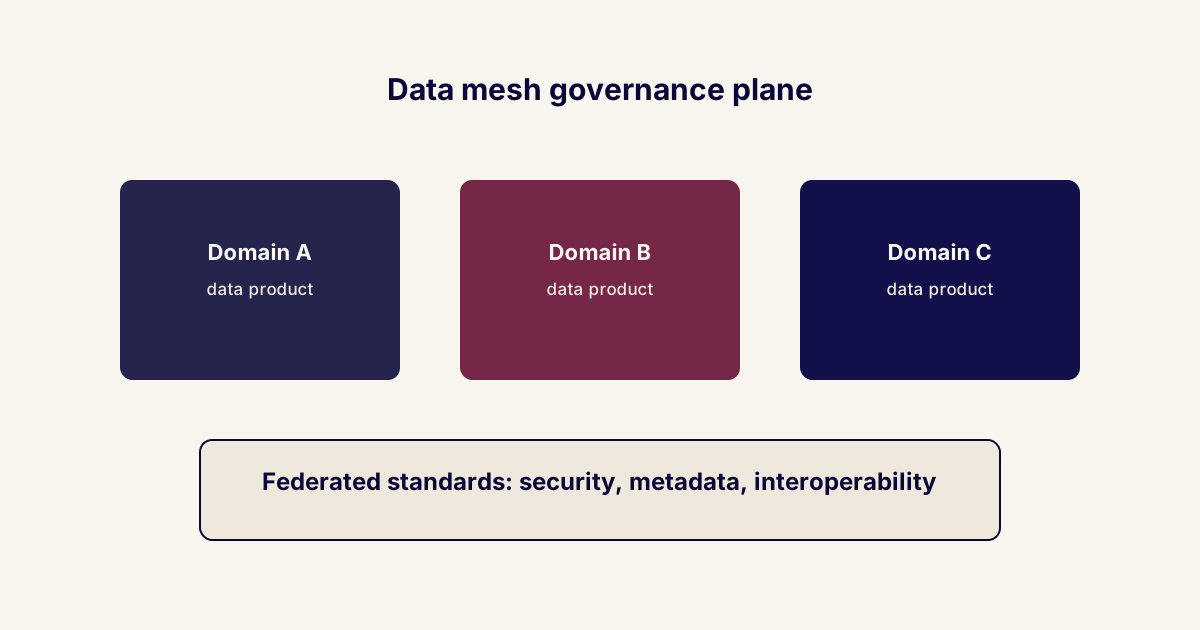
The most effective pattern we see in regulated industries is pairing lightweight data contracts at domain boundaries with automated checks embedded in continuous integration pipelines. Each producing team publishes a contract that declares the schema, freshness guarantees, and acceptable null rates for the datasets it exposes. Consuming ML teams reference those contracts programmatically. When a contract breaks, the CI pipeline fails before any training job can ingest stale or malformed data, preventing silent model degradation.
Data contracts work best when they are versioned alongside the code that produces the data. Treat a contract change the same way you treat an API version bump: announce it, provide a migration window, and deprecate the old version on a published timeline. This discipline prevents the all-too-common scenario where an upstream schema change silently breaks a downstream feature pipeline, and nobody notices until model performance degrades in production days or weeks later.
The data catalog should serve as the authoritative system of record, not a side project that a platform team maintains grudgingly. A well-maintained catalog maps every dataset to its owner, its contract version, its sensitivity classification, and the downstream models that depend on it. When an incident occurs, engineers should be able to trace from a degraded prediction back through the feature store, through the transformation logic, all the way to the raw source, in minutes rather than hours.
We facilitate small-group sessions for customers and prospects without requiring a slide deck, focused on your stack, constraints, and the decisions you need to make next.
Lineage tracking is the single capability that separates governance programs ML teams value from those they ignore. If a model starts producing biased predictions after a retraining run, the first question is always which data changed. Column-level lineage that records transformations, joins, and filter conditions gives ML engineers the forensic trail they need. Without it, debugging becomes guesswork, and regulators receive vague answers that erode trust in the organization's data practices.
Automated pipeline gates replace what humans used to negotiate in email threads and committee meetings. Instead of requesting manual approval for each new data source, teams define policies as code: sensitivity thresholds, retention windows, geographic residency rules, and minimum quality scores. The orchestration layer evaluates these policies at runtime and either proceeds or blocks with a clear, actionable error message. This approach scales to hundreds of pipelines without adding headcount to the governance team.
Access control in ML environments must be granular enough to satisfy regulators while remaining simple enough that data scientists do not circumvent it. Role-based access at the dataset level is a reasonable starting point, but mature organizations implement column-level masking and row-level filtering for sensitive attributes. A data scientist building a churn prediction model should not need access to raw social security numbers simply because they exist in a table that also contains useful behavioral features.
Feature stores introduce a natural governance boundary that many organizations underutilize. When features are registered, versioned, and served through a centralized store, governance policies can be applied at the feature level rather than the raw data level. This means you can enforce freshness checks, monitor for drift, and audit consumption patterns in one place. Teams that govern at the feature layer report faster audit preparation and fewer compliance findings during external examinations.
Metadata management is the connective tissue that holds governance programs together. Every dataset, feature, model, and pipeline should carry structured metadata describing its provenance, update frequency, sensitivity tier, and responsible owner. This metadata powers search, impact analysis, and automated compliance reporting. Investing in a metadata ingestion framework that pulls attributes from orchestration tools, version control systems, and model registries pays dividends across every governance use case.
Regulators in financial services, healthcare, and insurance increasingly demand explainability and reproducibility for models that influence consumer outcomes. Governance frameworks must capture not only which data was used but also which version of the training code, which hyperparameters were selected, and which evaluation metrics justified promotion to production. Storing this information in a model registry that links back to the data catalog creates an end-to-end audit trail that withstands regulatory scrutiny.
Retention policies deserve more attention than they typically receive in ML governance programs. Training datasets, intermediate features, and model artifacts accumulate rapidly and carry both storage costs and legal exposure. Define retention windows based on regulatory requirements and business needs, then enforce them through automated lifecycle rules. When a dataset reaches its retention limit, dependent models should be flagged for retraining on compliant data rather than left running on expired inputs.

Incident drills are the most revealing test of whether a governance program works in practice. Schedule quarterly exercises where a cross-functional team simulates a data quality incident, a privacy breach, or a regulatory inquiry. Measure how quickly engineers can identify affected datasets, trace lineage to impacted models, and produce the documentation a regulator would request. The gaps these drills reveal are far more valuable than any maturity model scorecard sitting in a shared drive.
Schema evolution is a persistent source of friction between data producers and ML consumers. Additive changes, such as new columns, are generally safe, but renaming or removing columns can break feature pipelines silently. Enforce backward compatibility rules through contract validation in CI, and require explicit deprecation notices before breaking changes ship. Teams that adopt this discipline report fewer production incidents tied to upstream data changes and spend less time on emergency feature pipeline repairs.
Cross-functional collaboration between data engineering, ML engineering, and compliance teams is essential for governance that endures. Governance defined exclusively by a compliance office tends to be disconnected from engineering reality. Governance defined exclusively by engineers tends to overlook regulatory nuance. The most resilient programs establish a small working group with representation from all three disciplines, empowered to make binding decisions about policy, tooling, and exception handling.
Measuring governance effectiveness requires metrics that go beyond checkbox completion rates. Track the percentage of production models with complete lineage documentation, the average time to trace a prediction back to its source data, the number of pipeline failures caught by contract validation before reaching production, and the reduction in audit preparation hours year over year. These indicators demonstrate tangible value and help justify continued investment in governance infrastructure.
Tooling choices should prioritize integration with existing ML workflows over standalone dashboards that nobody visits. Governance capabilities embedded in notebook environments, orchestration platforms, and model serving frameworks see higher adoption than centralized portals that require engineers to context-switch. Evaluate tools based on whether they meet data scientists where they already work, support policy-as-code patterns, and expose APIs that automation can consume without manual intervention.
Cultural adoption ultimately determines whether a governance program thrives or withers. Position governance as a capability that accelerates experimentation by removing ambiguity about data quality, ownership, and compliance status. Celebrate teams that contribute lineage metadata and maintain accurate catalogs. When governance is perceived as a tax, engineers find workarounds. When it is perceived as a service that makes their jobs easier and their models more reliable, participation becomes self-sustaining across the organization.