Insights · Article · Operations · May 2026
Single threaded command, communications cadence, legal engagement triggers, and post-incident learning that scales beyond a heroic on-call individual.

Production incidents test organizational clarity under pressure. When a critical service degrades, the difference between a well-coordinated response and a chaotic scramble often comes down to whether roles were defined before the alert fired. A cross-functional RACI matrix, mapping who is Responsible, Accountable, Consulted, and Informed across every incident phase, gives teams a shared playbook that eliminates ambiguity. Without it, responders waste precious minutes negotiating authority while customers bear the cost of confusion.
The financial and reputational damage of poorly coordinated incident response extends well beyond the immediate downtime window. Customers who receive conflicting status updates lose confidence in the organization's competence. Internal teams that lack clear ownership duplicate effort or, worse, leave critical tasks unaddressed because each group assumes another team is handling them. RACI eliminates these coordination failures by assigning explicit roles before stress hormones cloud judgment and communication channels become saturated with noise.
A production incident RACI matrix should cover four distinct phases: detection, triage, mitigation, and resolution. Each phase involves different stakeholders and demands different decision rights. During detection, monitoring systems and on-call engineers are responsible, while the incident commander role may not yet be activated. As the incident escalates into triage, the commander assumes accountability for operational decisions and the communications lead begins drafting initial stakeholder updates based on verified facts.
The incident commander should be single-threaded during the acute phase, focused exclusively on coordinating the response rather than writing code or debugging systems. This separation of concerns is essential because commanders who also perform technical remediation inevitably neglect coordination, leaving other responders without direction. Rotate the commander role across qualified engineers on a regular cadence to build organizational depth. Relying solely on senior staff creates a fragile dependency that collapses during vacations or concurrent incidents.
Commander authority must be unambiguous. When an incident is declared, the commander has the final word on operational decisions, resource allocation, and escalation timing. This does not mean the commander works alone or ignores input from specialists. Domain experts provide recommendations, and the commander synthesizes those inputs into decisive action. Teams that dilute commander authority with committee-style decision-making during active incidents consistently experience longer resolution times and more confused customer communications.
We facilitate small-group sessions for customers and prospects without requiring a slide deck, focused on your stack, constraints, and the decisions you need to make next.
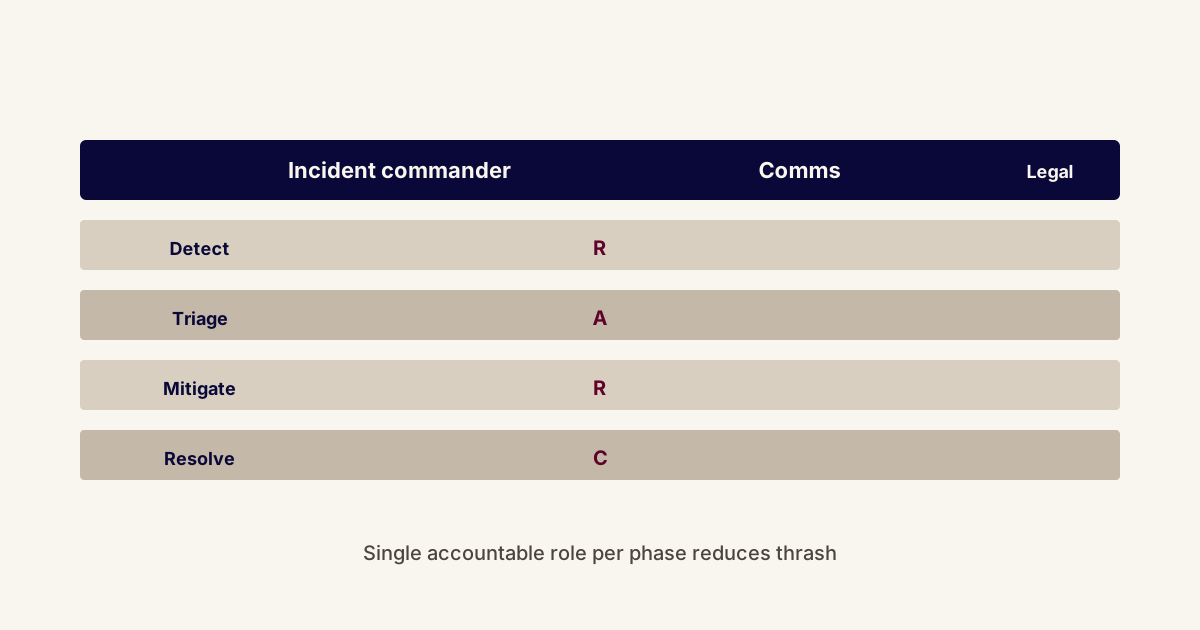
Communications roles should be explicitly separated from technical response. A dedicated communications lead owns all external and executive messaging, ensuring that status pages, customer emails, and leadership briefings present a consistent narrative. When technical responders also handle communications, updates arrive late, contain jargon that confuses non-technical stakeholders, or inadvertently disclose sensitive details about system architecture. The communications lead translates technical progress into clear, honest language that respects both customer anxiety and contractual notification obligations.
Legal and privacy engagement triggers belong on a pre-built decision tree, not in the judgment of an engineer working under pressure at two in the morning. Define explicit criteria based on data categories affected, jurisdictions involved, and contractual timelines that mandate notification. When personal data exposure is possible, legal counsel should be engaged within the first hour, not at hour six when the breach notification window has already narrowed dangerously and remediation options have diminished significantly.
Engineering execution during an incident requires domain owners who understand the affected systems deeply enough to diagnose and remediate quickly. The incident commander coordinates these experts but should not become the sole person executing changes in production. Assign responsible engineers for each affected service, and ensure those engineers have pre-provisioned access to production environments, runbooks, and escalation contacts for their upstream and downstream dependencies. Access provisioning during an active incident is a preventable delay that compounds resolution time.
Customer support and success teams occupy a critical position in the RACI matrix as the primary interface with affected users. These teams need scripted holding statements approved during calm periods, covering common incident scenarios and severity levels. Ad-libbed empathy, while well-intentioned, can overpromise recovery timelines or inadvertently confirm details the organization has not yet verified. Pre-approved templates preserve trust while giving support staff the confidence to respond quickly and consistently across all channels.
Escalation paths deserve the same level of pre-planning as technical runbooks. Define clear severity levels with objective criteria for each tier, and map those severities to specific escalation actions. A severity-one incident that affects revenue-generating services should automatically page the incident commander, communications lead, and engineering leadership. Lower severities may only require the on-call engineer and their team lead. Ambiguous severity definitions cause either over-escalation fatigue or dangerous under-escalation of genuine emergencies.

Post-incident reviews represent the highest-leverage activity in the entire incident lifecycle, yet many organizations treat them as administrative obligations rather than learning opportunities. Effective reviews assign an accountable owner for each action item, attach realistic due dates, and track completion through the same project management tools the team already uses. Generic lessons-learned documents that list observations without ownership consistently rot in shared drives, producing no lasting improvement in system reliability or response coordination.
The review itself should follow a structured format that separates timeline reconstruction from root cause analysis and remediation planning. Begin with an objective timeline built from monitoring data, chat logs, and deployment records rather than memory alone. Identify contributing factors without assigning individual blame, because blameful reviews discourage honest disclosure and drive future incident details underground. Focus remediation items on systemic improvements: better alerting, automated failover, improved runbooks, and architectural changes that prevent recurrence.
Measuring RACI effectiveness requires metrics that capture both speed and coordination quality. Track time to first public status update, time from detection to containment, percentage of incidents with an assigned communications lead, and repeat incident rate for the same root cause class. These indicators reveal whether roles are being filled consistently and whether post-incident actions are actually reducing recurrence. Review metrics monthly with engineering and operations leadership to identify trends and adjust training priorities accordingly.
Tooling supports RACI adoption but cannot replace it. Incident management platforms that auto-assign roles based on affected services, route notifications to the correct stakeholders, and maintain a timestamped audit trail reduce cognitive load during high-stress moments. However, no tool compensates for a team that has never practiced its roles under simulated pressure. Invest in platforms that reinforce your existing RACI structure, and resist the temptation to substitute tool configuration for genuine organizational alignment and rehearsal.
Game days and tabletop exercises transform RACI from a static document into practiced behavior. Schedule quarterly simulations that exercise the full incident lifecycle, including detection, commander activation, communications drafts, legal escalation, and post-incident review. Rotate participants across roles so that engineers experience the communications perspective and support staff understand technical constraints. Muscle memory built through disciplined repetition beats laminated wall posters every time, because real incidents never pause to let responders consult a reference chart.
Cross-functional RACI for production incidents is not bureaucracy layered onto engineering speed. It is the operational backbone that allows diverse teams to converge under pressure with shared expectations and clear authority. Organizations that invest in defining roles, practicing responses, and measuring coordination quality consistently resolve incidents faster, communicate more transparently, and retain customer trust through disruptions that would paralyze less-prepared competitors. Build the matrix now, and practice it before the next alert fires.