Insights · Article · Operations · Apr 2026
Blast radius limits, abort conditions, stakeholder paging, and fault budgets so resilience games strengthen systems instead of surprising customers.

Chaos engineering has matured from a bold experiment at a handful of technology giants into a core reliability practice across industries. The premise is straightforward: inject controlled faults into systems, observe how they respond, and use the findings to harden architecture before real incidents occur. Done well, chaos programs surface hidden dependencies, validate failover paths, and build institutional confidence in production resilience. Done carelessly, they become scheduled outages dressed in clever terminology.
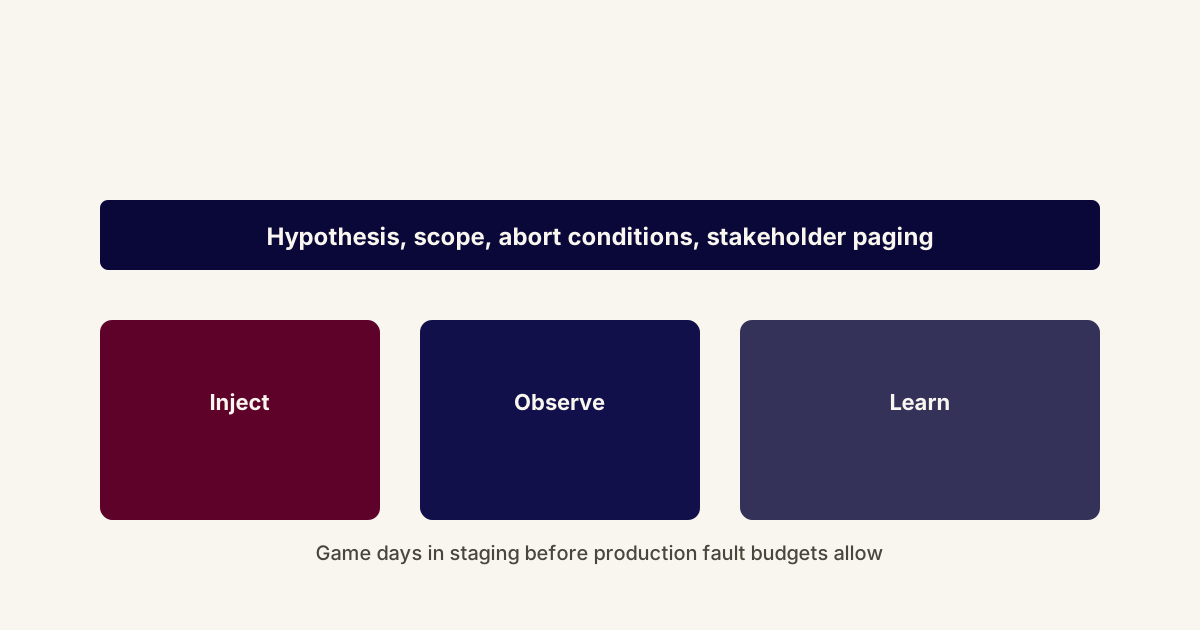
The distinction between productive chaos engineering and reckless fault injection lies in discipline. Mature programs treat every experiment as a controlled release with a clear hypothesis, a defined scope, measurable success criteria, and an instant rollback mechanism. Teams that skip this rigor risk degrading customer experience while producing findings that are difficult to act on. Structured experimentation, by contrast, yields actionable insights that translate directly into engineering backlog items with clear ownership.
Organizations new to chaos engineering should begin in non-production environments. Staging and pre-production clusters provide a safer context for teams to build muscle memory around fault injection workflows, observability tooling, and incident communication. Staging should mirror production topology closely enough to surface genuine failure modes, not simply restart a single container in isolation. Network partitions, dependency latency, and resource exhaustion scenarios all deserve attention before any experiment touches live traffic.
The transition from staging to production demands a formal readiness checklist. Teams should confirm that observability coverage is sufficient to detect experiment impact within seconds, that automated rollback mechanisms are tested and reliable, and that on-call engineers understand the experiment timeline. Without this foundation, production chaos experiments carry unacceptable risk and erode the organizational trust that future resilience work depends on.
We facilitate small-group sessions for customers and prospects without requiring a slide deck, focused on your stack, constraints, and the decisions you need to make next.
Production experiments must align with error budget policies. If a service is already in breach of its service level objective, introducing additional fault injection is irresponsible. Freeze chaos activity until reliability recovers to an acceptable baseline. Respect maintenance windows, regional holidays, and peak traffic periods. Scheduling experiments during low-traffic windows reduces blast radius and gives teams more breathing room to observe and respond without measurable customer impact.
Blast radius management is the single most important safety mechanism in production chaos engineering. Every experiment should define explicit boundaries: which services are in scope, what percentage of traffic is affected, and which geographic regions or availability zones participate. Start narrow. A five-percent traffic slice in a single region provides meaningful signal while limiting exposure. Expand scope only after each increment confirms system stability and acceptable error rates.
Automated abort conditions form the first line of defense when an experiment exceeds expected impact. Define clear thresholds for latency percentiles, error rate spikes, queue depth saturation, and downstream dependency health. When any threshold is breached, the experiment platform should halt fault injection and restore normal conditions without human intervention. Speed matters here: every second of delay between threshold breach and rollback translates to degraded customer experience.
Automated thresholds cannot capture every dimension of customer impact. Some degradation manifests as subtle shifts in conversion rates, session abandonment, or support ticket volume that metrics dashboards lag in surfacing. Human judgment remains essential for these nuanced scenarios. Designate an experiment owner who monitors real-time dashboards, customer feedback channels, and support queues throughout the experiment window. Empower that owner to abort at any point based on qualitative signals.
Stakeholder communication must be explicit and proactive. Product owners, support leads, customer success managers, and executive sponsors should all know when experiments are scheduled, what the expected impact range is, and who to contact if they observe anomalies. Surprise is the enemy of organizational trust. A simple shared calendar with experiment windows and a dedicated communication channel prevents the perception that engineering is being reckless with production systems.
Building trust with non-engineering stakeholders often determines whether a chaos program scales or stalls. Share results transparently, including experiments that revealed no weaknesses. Demonstrate that the program operates within guardrails and respects business priorities. Over time, product and business leaders become advocates rather than skeptics because they see the direct connection between controlled experiments and fewer customer-facing incidents during peak periods.
Every experiment must conclude with documented learnings captured as actionable tickets with assigned owners and target resolution dates. An experiment that reveals a weakness but produces no remediation work is entertainment, not engineering. Categorize findings by severity and blast radius. Prioritize fixes that reduce correlated failure across availability zones, since these represent the highest risk to overall system resilience and are often the hardest to detect through conventional testing.
Remediation work should feed back into the experiment pipeline. After a fix is deployed, re-run the original experiment to validate that the weakness has been addressed. This closed-loop approach builds a resilience regression suite over time, giving teams confidence that previously discovered vulnerabilities remain resolved as the system evolves. Without re-validation, organizations accumulate a growing list of findings with no assurance that the fixes actually hold under pressure.

Security and compliance teams must be engaged early in the chaos engineering program. Certain fault types, such as data corruption or authentication bypass simulations, may be restricted in regulated environments. Data destruction scenarios belong in tightly scoped sandboxes populated with synthetic data. Coordinate with governance stakeholders to define an approved experiment catalog that balances resilience goals with regulatory obligations. Document these approvals as part of your compliance audit trail.
In industries subject to frameworks like SOC 2, HIPAA, or PCI DSS, chaos experiments can actually strengthen compliance posture when executed properly. Regulators increasingly expect organizations to demonstrate proactive resilience testing. Frame chaos engineering findings as evidence of continuous improvement and include experiment summaries in audit documentation. This positions the program as a compliance asset rather than a risk, which helps secure ongoing executive sponsorship and budget.
Leadership reporting should focus on outcomes rather than experiment counts. Meaningful metrics include the reduction in undiscovered single points of failure, faster mean time to mitigation after targeted drills, percentage of services with defined resilience service level objectives, and the ratio of findings to completed remediations. These indicators demonstrate program maturity and connect resilience investment to measurable risk reduction in language that executives and board members understand.
Selecting the right tooling platform accelerates program adoption. Open source options like Chaos Monkey, Litmus, and Chaos Mesh provide solid foundations, while commercial platforms add scheduling, approval workflows, and integrated reporting. Evaluate platforms on their ability to enforce blast radius limits, automate abort conditions, and integrate with your existing observability stack. The best tool is the one your teams will actually use consistently, not the one with the longest feature list.
Cultural adoption determines long-term program success more than tooling or process. Introduce chaos engineering as a learning practice, not a test that services pass or fail. Celebrate experiments that reveal weaknesses because those findings represent prevented incidents. Avoid blame when experiments cause unexpected impact; instead, treat those moments as opportunities to improve both the system and the experiment design. A blameless culture encourages broader participation and more ambitious experiments over time.
Rotate experiment facilitators across teams so that resilience skills and institutional knowledge spread throughout the organization. A single chaos champion becomes a bottleneck and a vacation risk. Cross-training engineers from different service teams also surfaces fresh perspectives on failure modes that domain experts may overlook. Pair junior engineers with experienced facilitators during their first few experiments to accelerate learning while maintaining safety standards.
Chaos engineering, when wrapped in disciplined guardrails, transforms from a niche practice into a strategic capability. Organizations that invest in structured experimentation, transparent communication, and closed-loop remediation build systems that degrade gracefully under real-world pressure. The goal is not to eliminate failure but to ensure that when failure occurs, its impact is contained, its duration is minimized, and the team response is practiced and confident.