Insights · Article · Strategy · Sep 2025
Designing CAB around risk tiers, automated evidence, and trust, not theater.

Change advisory boards occupy a paradoxical position inside most technology organizations. They exist to prevent outages, protect customer experience, and satisfy regulatory scrutiny, yet they routinely become the single largest bottleneck between a finished feature and a production deployment. The root cause is rarely malicious intent. It is almost always a structural mismatch between how risk is assessed and how software actually moves through modern delivery pipelines.
Traditional CAB formats inherited from ITIL v2 treat every change request identically. A cosmetic copy update, a critical database migration, and a routine dependency patch all receive the same thirty-minute presentation slot, the same approval quorum, and the same weekly meeting cadence. This uniformity creates an illusion of rigor while delivering almost none of it. Genuine high-risk changes get diluted in a queue of trivial items, and engineers learn to game the process rather than engage with it honestly.
CABs earn a bad reputation when every change looks identical in the agenda. Risk-tiered paths with pre-approved automation for low-risk deploys keep focus on material customer and regulatory impact. Organizations that segment changes into three or four clearly defined risk tiers consistently ship faster while maintaining stronger audit postures than those relying on a single approval workflow for everything.
Designing effective risk tiers requires collaboration between engineering, security, compliance, and product leadership. A practical starting taxonomy separates standard changes, which are repeatable and well understood, from normal changes that carry moderate blast radius, and emergency changes that demand expedited review. Each tier maps to a distinct approval path: automated gate, lightweight peer review, or full board convocation. The key principle is that the approval cost should be proportional to the actual organizational risk, never higher and never lower.
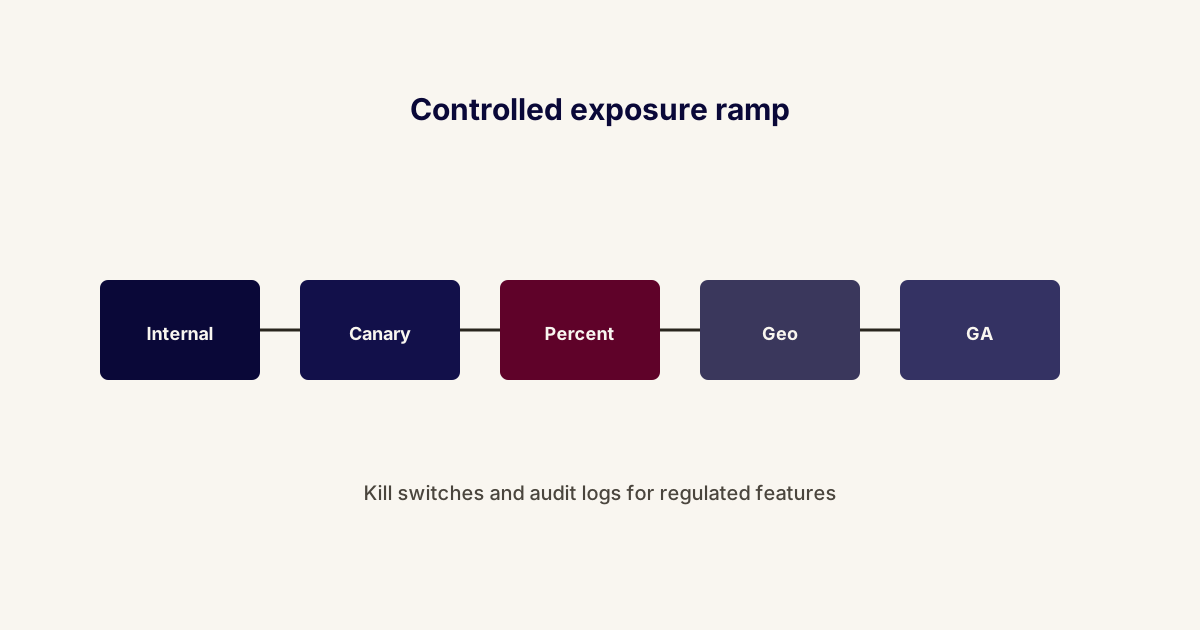
Pre-approved change templates accelerate standard deployments without sacrificing governance. When a deployment matches a known pattern, such as a configuration flag toggle within a feature management platform, the pipeline itself validates compliance criteria and records the approval decision. Human reviewers never see these changes in a meeting agenda. Instead, they receive a weekly digest summarizing volume, success rates, and any anomalies, freeing their attention for changes that genuinely require judgment.
We facilitate small-group sessions for customers and prospects without requiring a slide deck, focused on your stack, constraints, and the decisions you need to make next.
Evidence should be generated by pipelines: test results, canary metrics, and rollback readiness checks attached to the ticket, not slides assembled the night before. Automated evidence collection eliminates the most wasteful ritual in legacy CAB processes, where an engineer spends hours building a presentation deck that a board member skims for two minutes before voting. When the pipeline produces the evidence, it is both more reliable and more timely.
Canary analysis deserves particular attention within the evidence portfolio. A well-instrumented canary deployment compares error rates, latency percentiles, and business conversion metrics between the baseline and the candidate release in real time. Presenting this data to the CAB as a structured scorecard, rather than a narrative summary, enables faster and more consistent decision-making. Board members can focus on interpreting thresholds rather than deciphering anecdotal status updates.
Rollback readiness is the single most undervalued safety control in change management. If every deployment can be reversed within minutes, the residual risk of any individual change drops dramatically. CABs should require evidence of rollback capability rather than exhaustive pre-deployment testing alone. A team that can demonstrate a tested, automated rollback procedure earns a fundamentally different risk profile than one relying solely on forward-fix promises under pressure.
Meeting cadence itself shapes organizational velocity. Weekly CAB sessions create an artificial batch cycle that forces deployments into a seven-day queue regardless of readiness. Progressive organizations move to asynchronous approval for standard and normal tiers, reserving synchronous meetings exclusively for high-risk or emergency changes. Asynchronous review, supported by structured change request forms in a shared toolchain, reduces cycle time from days to hours without weakening oversight.
Rotate business stakeholders through CAB as observers quarterly. When product leaders see how safety constraints map to release velocity, prioritization conversations improve upstream. This rotation also demystifies engineering operations for nontechnical leaders. Product managers who have witnessed the real-world consequences of a failed deployment become far more receptive to investing in deployment infrastructure, automated testing, and observability tooling during roadmap planning.
Trust is the currency that determines whether a CAB functions as a governance body or a bureaucratic checkpoint. Trust accrues when teams consistently deliver accurate risk assessments, honest evidence, and transparent post-incident reviews. It erodes when teams understate risk to avoid scrutiny or when the board imposes blanket change freezes after a single incident. Leaders must protect the trust economy by rewarding candor and penalizing obfuscation, regardless of the outcome of any individual deployment.

Post-incident integration closes the feedback loop that keeps CAB policies calibrated to actual organizational risk. After every significant incident, the board should review whether existing risk tiers would have caught the failure, whether the evidence requirements were sufficient, and whether the approval path matched the true blast radius. This retrospective discipline prevents the common failure mode where CAB policies ossify around risks that no longer exist while ignoring emerging threat vectors.
Compliance frameworks such as SOC 2, ISO 27001, and PCI DSS require demonstrable change management controls, but none of them mandate a weekly committee meeting. Auditors care about segregation of duties, traceability, and evidence retention. An automated pipeline that enforces branch protection rules, requires code review from an independent approver, and archives deployment artifacts in an immutable log satisfies these requirements more robustly than a handwritten meeting minute ever could.
Tooling choices matter, though they are secondary to process design. Integrating the change request workflow directly into the existing developer toolchain, whether that means pull request metadata, deployment pipeline annotations, or service catalog entries, reduces context switching and increases adoption. Separate change management portals that duplicate information already present in version control introduce friction and data drift without adding meaningful governance value.
Measuring CAB effectiveness requires metrics beyond approval throughput. Track the ratio of changes approved to changes that caused incidents. Monitor the elapsed time between code merge and production deployment, segmented by risk tier. Survey engineering teams on perceived friction and trust in the process. A healthy CAB will show declining cycle times, stable or improving incident ratios, and rising confidence scores from the teams it governs.
Cultural transformation is the hardest and most important dimension of CAB reform. Engineers who have spent years treating the board as an adversary will not shift overnight. Leaders must signal the new operating model through visible actions: retiring legacy approval forms, celebrating teams that provide exemplary automated evidence, and publicly acknowledging when the board itself makes a mistake. The goal is a shared understanding that the CAB exists to help teams ship safely, not to prevent them from shipping at all.
Organizations that redesign their change advisory boards around risk proportionality, automated evidence, and institutional trust consistently achieve two outcomes that legacy models cannot deliver simultaneously. They ship more frequently, often moving from weekly to daily or even continuous deployment, while also reducing the severity and frequency of production incidents. The mechanism is straightforward: when governance is lightweight for safe changes and rigorous for dangerous ones, teams invest their energy where it matters most.