Insights · Article · Engineering · Apr 2026
Time to Live tuning, intelligent purge APIs, complex surrogate keys, and stale while revalidate architecture patterns that keep core origins perfectly healthy during massive global traffic spikes.

Content Delivery Networks underpin virtually every high-traffic digital product, yet they harbor a deceptively dangerous failure mode: stale content served at scale. When cached assets fall out of sync with origin data, the consequences range from frustrated users seeing outdated pricing to compliance violations that invite regulatory scrutiny. Conversely, an overly aggressive cache purge can strip edge protection away from origin infrastructure, funneling millions of concurrent requests into backend systems never designed to absorb that load directly.
An effective invalidation strategy sits at the intersection of software architecture, operational discipline, and business coordination. Organizations that treat cache invalidation as an afterthought routinely discover the cost during their highest-stakes moments: product launches, breaking news cycles, and flash sales. Building a deliberate, layered approach to cache lifecycle management is not optional for any platform operating at global scale; it is a core engineering competency that protects revenue and reputation simultaneously.
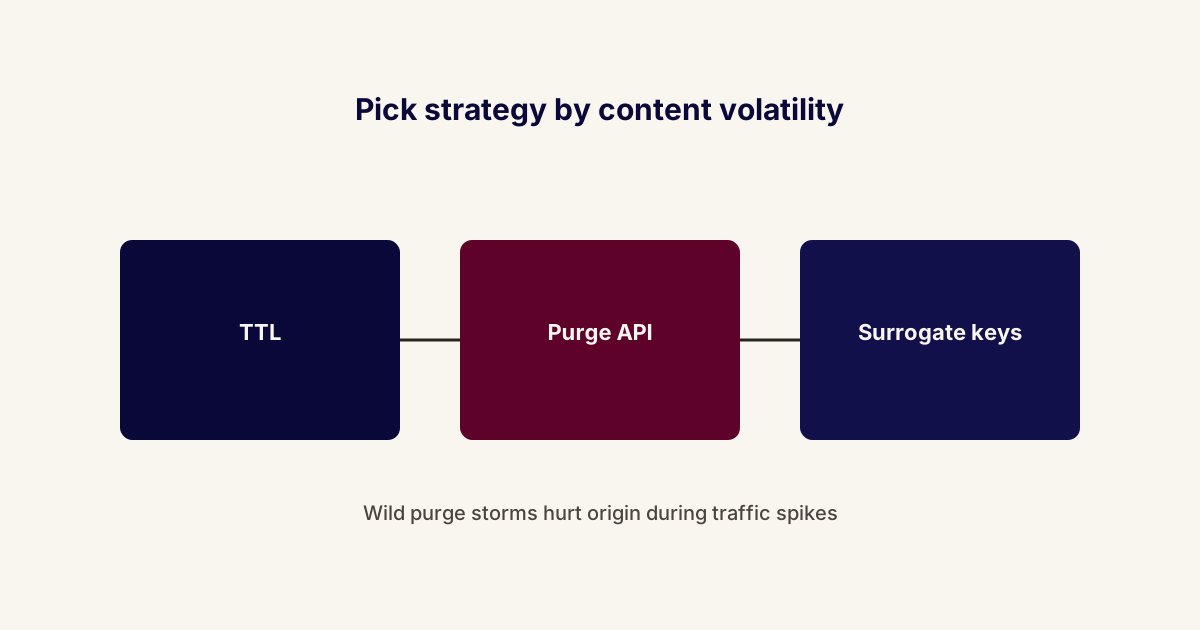
Time to Live configuration is the foundational lever in every CDN deployment. A TTL value dictates how long an edge node may serve a cached object before requesting a fresh copy from the origin. Setting this value demands nuanced segmentation by content type rather than a single blanket policy. Static assets such as JavaScript bundles, CSS stylesheets, and image sprites compiled with content-hash filenames can safely carry TTL values measured in months or even years, because any code change produces a new filename that bypasses the old cache entry entirely.
Dynamic content requires a fundamentally different calculus. HTML document shells, API responses containing inventory counts, and personalized recommendation feeds may need TTL values as short as a few seconds, or they may rely on event-driven purge mechanisms instead of time-based expiry. The discipline of mapping every cacheable resource to a TTL tier prevents the common antipattern of setting a uniform five-minute expiry across all assets, which simultaneously over-serves stale HTML and under-caches immutable binaries.
We facilitate small-group sessions for customers and prospects without requiring a slide deck, focused on your stack, constraints, and the decisions you need to make next.

Surrogate keys, sometimes called cache tags, elevate invalidation from a blunt instrument to a surgical tool. Rather than purging an entire URL path or an entire domain, surrogate keys allow application code to associate cached objects with logical identifiers: a product SKU, a content category, or an author ID. When a product record changes in the database, a single API call referencing that surrogate key invalidates every edge-cached page containing that product, regardless of URL structure or geographic distribution.
Realizing the full value of surrogate keys demands rigorous engineering discipline throughout the build and deployment pipeline. Every response flowing through the CDN must carry accurate, complete key headers that reflect every data dependency embedded in the rendered output. If a product detail page depends on both inventory data and promotional pricing, both surrogate keys must be present. Missing a single key creates a silent inconsistency that only surfaces when a customer sees a price that no longer exists.
The stale-while-revalidate pattern offers an elegant compromise between freshness and performance. When a user requests an object whose TTL has recently expired, the edge node immediately returns the slightly stale version while dispatching an asynchronous background fetch to the origin. The user perceives zero latency penalty, and the cache refreshes transparently for subsequent visitors. This pattern is particularly valuable for content that changes frequently but tolerates a brief window of staleness, such as editorial homepages or product listing pages.
However, stale-while-revalidate introduces a compliance risk that engineering teams must address explicitly. If a legal takedown order, a product recall notice, or a regulatory mandate requires immediate removal of specific content, the edge network must not continue serving the prohibited asset during a background refresh cycle. Organizations need a secondary hard-purge mechanism that overrides stale-while-revalidate behavior for these critical scenarios, and operational runbooks must clearly distinguish between routine revalidation and mandatory immediate removal.
Purge APIs are the programmatic interface through which applications and operators trigger cache invalidation. These endpoints must be protected with robust authentication, strict rate limiting, and mathematical idempotency. A single misfire, whether from a rogue script, a compromised credential, or a developer testing in production, can wipe the entire edge cache and send a thundering herd of requests crashing into origin servers. Rate limits on purge endpoints should be tuned to permit legitimate burst operations during deployments while blocking runaway loops.
Site reliability runbooks must contain explicit procedures for recovering from an accidental full-site cache purge. These procedures should include automatic connection shedding at the origin load balancer, progressive traffic admission to rebuild the cache gradually, and pre-staged synthetic requests that re-warm the most frequently accessed objects. Without rehearsed recovery plans, a full purge during peak hours can cascade into a sustained outage that takes hours to stabilize.
Multi-CDN architectures, increasingly common among enterprises seeking resilience and geographic optimization, amplify the complexity of invalidation dramatically. When two or three CDN vendors front the same origin, a purge issued to one provider does not automatically propagate to the others. Internal orchestration tooling must fan out invalidation commands to every active vendor, confirm execution, and reconcile any failures. Surrogate key semantics may differ across providers, requiring a normalization layer that translates application-level tags into vendor-specific API payloads.
Cache key design itself is an underappreciated architectural decision. The cache key determines which request attributes distinguish one cached variant from another. Including unnecessary query parameters or headers in the key fragments the cache into countless low-hit-ratio variants, effectively negating the CDN's value. Conversely, omitting a meaningful differentiator, such as a language header or a device-class indicator, causes the wrong content variant to be served. Careful key normalization, including query parameter sorting and whitespace stripping, reduces fragmentation without sacrificing correctness.
Version-stamped deployments offer a complementary strategy that sidesteps traditional invalidation entirely for immutable assets. By embedding a build identifier or content hash into every asset URL at compile time, each deployment produces a unique set of URLs that will never collide with prior versions. The old URLs simply age out of the cache naturally, and no explicit purge is required. This approach works seamlessly for frontend bundles and static media but cannot address dynamic HTML or API responses that share stable URL paths across releases.
Observability is the connective tissue that turns cache management from guesswork into engineering. Teams should instrument dashboards tracking edge hit ratios by content tier, origin request volume, purge command latency, and error rates on revalidation fetches. A gradual decline in hit ratio often serves as an early warning signal, preceding user-facing degradation by minutes or hours. Alerting thresholds tied to hit ratio drops and origin CPU utilization spikes enable proactive intervention before customers notice a problem.
Geographic and regulatory considerations add another layer of complexity to invalidation planning. Content subject to data residency requirements may only be cached in specific regions, and purge commands must account for regional edge node populations. Similarly, personalization layers that vary content by visitor location must ensure that purge logic targets all relevant geographic variants. Organizations operating under GDPR, CCPA, or similar frameworks should map their cache topology against compliance obligations to confirm that personal data can be reliably and verifiably purged within mandated timeframes.
Testing invalidation strategies in staging environments is essential yet frequently neglected. Teams should simulate purge scenarios, stale-while-revalidate edge cases, and multi-CDN failover conditions well before production traffic depends on them. Load testing should include cache-cold scenarios that model the worst-case origin impact of a full purge. Chaos engineering techniques, such as randomly invalidating cache segments during synthetic load tests, reveal weaknesses in recovery procedures that would otherwise remain hidden until a real incident exposes them.
Finally, technical execution must align tightly with business operations. Marketing campaigns, editorial embargoes, and product launches all create moments when cache behavior directly affects commercial outcomes. Coordinating scheduled purges with pre-warming routines ensures that freshly invalidated content is already populated at the edge before peak traffic arrives. Cross-functional runbooks that connect campaign calendars to infrastructure playbooks prevent the all too common scenario where a Monday morning promotion drives a stampede into an unprotected origin, converting a revenue opportunity into a high-visibility outage.