Insights · Article · Engineering · May 2026
Statistical power, multiple comparisons, novelty effects, and precise metric choices so gradual rollouts inform decisions instead of rubber stamping whatever the dashboard showed at lunch.

Canary deployments fundamentally trade immediate production risk for long term analytical ambiguity. Routing exactly five percent of global user traffic to a newly deployed microservice safely limits the blast radius of a catastrophic bug, but it simultaneously creates a deeply complex mathematical environment. Five percent of traffic can hide a devastating tail latency increase, or conversely, it can look entirely catastrophic simply because variance is naturally high and eager engineers peeked at the monitoring dashboard too early.
The appeal of canary releases is obvious: they promise controlled exposure to change with a built in safety net. Yet this promise collapses when teams treat statistical dashboards as definitive verdicts rather than probabilistic signals. A green metric at the two minute mark carries almost no inferential weight. Organizations that confuse early silence with confirmed safety routinely promote broken builds, only to discover regressions hours later when cumulative traffic volumes finally expose the underlying defect.
Before any platform engineering team can safely automate promotions or rollbacks, they must explicitly define their primary success metrics, absolute safety guardrails, and a strict minimum exposure time window. Altering these definitions mid flight invalidates the statistical integrity of the entire experiment. When developers rationalize away a minor error rate spike, it trains the entire organization to distrust the automated deployment process, eroding confidence in the very infrastructure designed to accelerate delivery velocity.
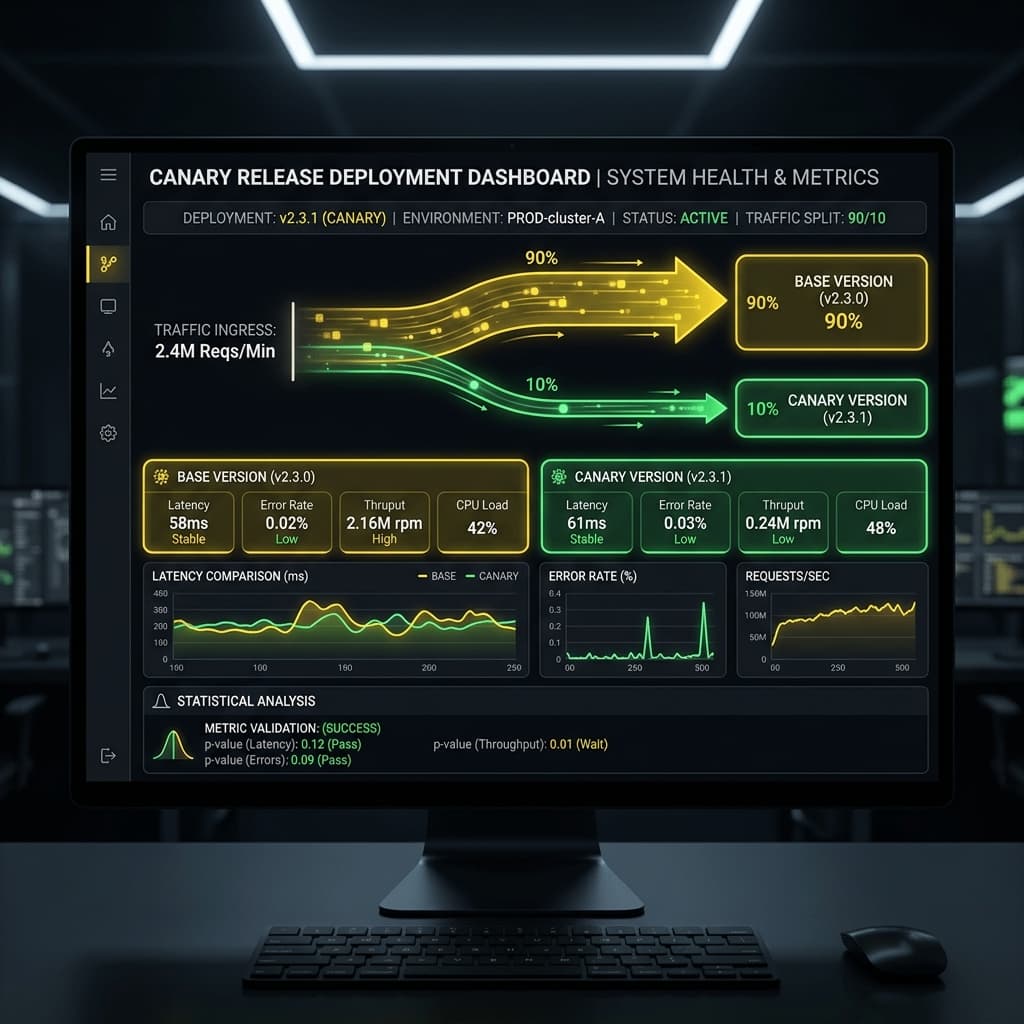
The problem of multiple statistical comparisons frequently inflates false positive deployment failures. If an automated system watches the HTTP 500 error rate, the 99th percentile latency curve, frontend memory consumption, and aggregate revenue per session simultaneously without any correction, it will inevitably roll back a perfectly healthy software build purely by random variance. Engineers must apply corrections like the Bonferroni method to account for evaluating multiple metrics concurrently.
We facilitate small-group sessions for customers and prospects without requiring a slide deck, focused on your stack, constraints, and the decisions you need to make next.
Bonferroni correction is the simplest approach, dividing the significance threshold by the number of concurrent tests, but it is notoriously conservative. When a canary evaluation monitors fifteen metrics simultaneously, the adjusted alpha becomes so small that genuine regressions slip through undetected. More sophisticated alternatives, such as the Holm sequential procedure or Benjamini Hochberg false discovery rate control, offer a better balance between sensitivity and specificity for real world deployment pipelines.
Statistical power is the complement of this problem. If the canary cohort is too small, no correction method can rescue the experiment from insufficient sample size. Teams must calculate the minimum detectable effect size before launch. A canary that can only detect a fifty percent increase in error rate is operationally useless if the business cares about a two percent regression. Power analysis is not optional; it is a prerequisite for every deployment gate that claims to be data driven.
Exposure time compounds the sample size challenge. Even with adequate traffic volume, certain failure modes only manifest after sustained load. Memory leaks, connection pool exhaustion, and gradual cache poisoning all require minutes or hours to surface. Premature evaluation, often called the peeking problem, dramatically inflates type one error rates. Sequential testing frameworks such as CUSUM charts or always valid confidence intervals allow continuous monitoring without sacrificing statistical rigor.
Novelty effects and learning curves matter immensely for any user experience changes bundled into a canary release. Users naturally click newly designed prominent buttons simply because they are visually new, not because the feature is objectively better. These initial usage spikes create wildly distorted positive data points. Without careful experimental design, product teams celebrate engagement lifts that vanish entirely within a week as users revert to habitual navigation patterns.
Establishing long running holdout cohorts helps data scientists separate temporary novelty metrics from genuine product engagement improvements. A holdout group that never receives the new build provides a stable baseline for weeks or months after the initial deployment. This technique is particularly valuable for subscription platforms, where the real measure of success is retention at the thirty day mark rather than click through rates on day one.
Traffic stratification is another critical layer. Organizations must actively stratify their canary traffic allocation by geographic region, device class, and specific enterprise tenant whenever known architectural heterogeneity exists. Relying purely on a global mathematical average can easily greenlight a backend deployment that performs flawlessly in North America while completely destroying the database shard located in Europe or degrading mobile performance in high latency markets.
Stratified allocation also protects against Simpson paradox, where an aggregate metric improves even though every individual subgroup degrades. This paradox is surprisingly common in multi tenant platforms where traffic mix shifts between peak and off peak hours. Engineering teams that evaluate canary health only at the global level risk systematically harming their most valuable customer segments while the overall dashboard remains reassuringly green.
Progressive rollout stages add further defense in depth. Rather than jumping from five percent directly to one hundred percent, mature organizations define intermediate stages at ten, twenty five, and fifty percent. Each stage carries its own bake time and metric thresholds. The benefit is twofold: earlier stages catch severe breakage cheaply, while later stages accumulate enough statistical power to detect subtle regressions that small cohorts simply cannot resolve.
Modern continuous delivery systems frequently pair synthetic monitoring and replicated shadow traffic alongside their canary strategies. Synthetic probes continuously exercise critical transaction paths with known expected outcomes, providing a deterministic signal that complements the probabilistic signal from live user traffic. Shadow traffic replays production requests against the canary without returning responses to users, enabling safe stress testing of new code paths before real customers ever encounter them.
Automation maturity directly influences how well these statistical safeguards function in practice. A pipeline that requires a human to interpret a chart and press a button is not truly automated; it is a manual gate dressed in a dashboard. Genuine canary automation encodes metric definitions, correction methods, minimum sample sizes, and bake times as declarative policy. This approach removes cognitive load from on call engineers and ensures that the same rigor applies at three in the morning as at three in the afternoon.
Engineering teams must heavily document post incident reviews whenever established statistical thresholds dramatically misfire. These written operational narratives improve the organization's prior assumptions significantly more than blindly tweaking a statistical alpha value from point zero five to point zero one without any underlying contextual understanding. Every false positive rollback and every missed regression contains lessons about metric selection, traffic composition, or environmental noise that should feed back into the deployment policy.
Organizational culture determines whether these lessons translate into lasting improvement. Teams that punish failed canaries incentivize engineers to circumvent the system entirely, either by deploying during low traffic windows to minimize statistical scrutiny or by manually overriding automated rollbacks. A healthier posture treats every canary outcome, whether promotion, rollback, or inconclusive result, as valuable operational data that refines the deployment pipeline over successive iterations.
Ultimately, integrating statistical canary routing decisions with legacy IT change management frameworks requires a careful balance. Human operators should retain the authority to override flawed automation. However, any manual override must require a documented written rationale, especially when human business context trumps a mathematically marginal metric movement. This audit trail protects both the engineering team and the business by creating an institutional memory of when and why automated judgment was overruled.