Insights · Article · Security · May 2026
Hardware Security Modules, envelope encryption diagrams, tenant isolation boundaries, rapid revocation procedures, and vendor access models when customers demand to bring their own cryptographic keys.

Bring Your Own Key programs promise enterprise customers absolute control over their cloud data encryption keys. The reality of implementing BYOK in a multi-tenant Software as a Service environment is far more complicated than vendor marketing materials suggest. When customers control primary cryptographic material, they introduce latency spikes, tight availability coupling across external network borders, and complex incident choreography. A customer who panic-revokes an active key during a legal dispute forces the SaaS provider to handle sudden cryptographic lockout without corrupting ongoing database transactions.
The first architectural prerequisite is clarifying exactly what your BYOK model technically guarantees. If decrypted plaintext still transits through application memory on vendor-controlled bare metal servers, the customer's key primarily protects stored data at rest on physical disk. It does nothing to protect against a malicious insider threat operating at the active application layer. Transparently documenting these boundary lines prevents catastrophic liability failures during pre-sales compliance reviews and regulatory audits that scrutinize encryption scope.

Hardware Security Modules sit at the foundation of any credible BYOK architecture. Customers increasingly demand that master keys reside exclusively inside FIPS 140-2 Level 3 certified hardware, whether deployed on premises or provisioned through a cloud-managed HSM service. The choice between dedicated HSM clusters and multi-tenant managed HSM pools directly affects cost, latency, and the cryptographic boundary that auditors evaluate. Engineering teams must validate that HSM failover configurations do not silently degrade key isolation guarantees during regional outages.
Modern implementations rely on envelope encryption paradigms. The customer provides a master Key Management Service key housed entirely inside their own external cloud perimeter. The SaaS platform generates a unique, rapidly rotating Data Encryption Key locally, encrypts the target data payload using that local key, then immediately wraps the local key using the customer's external master key. The resulting encrypted bundle is stored inside the database. Whenever data must be read, the platform executes an API call asking the customer's infrastructure to unwrap the protective layer.
We facilitate small-group sessions for customers and prospects without requiring a slide deck, focused on your stack, constraints, and the decisions you need to make next.
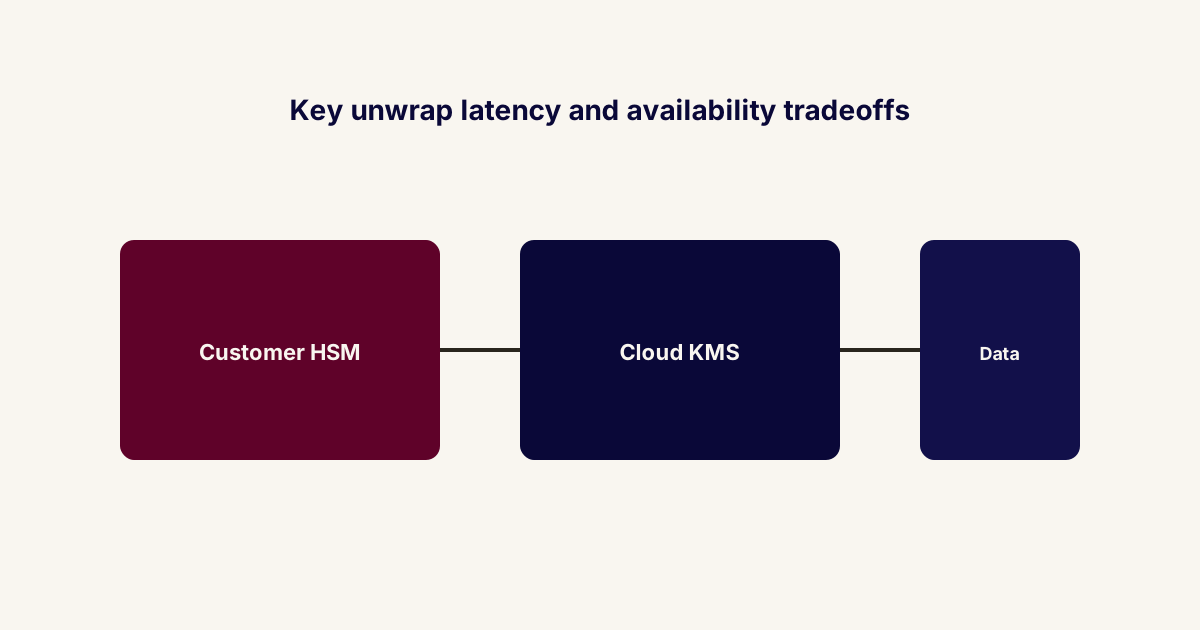
A well-designed key hierarchy typically spans three or more levels. The customer-owned root key protects intermediate tenant keys, which in turn protect granular Data Encryption Keys scoped to individual tables, partitions, or object storage buckets. This layered structure limits the blast radius of any single key compromise and enables surgical rotation at lower tiers without disrupting the entire encryption chain. Skipping hierarchy design leads to brittle architectures that auditors rightfully flag during certification reviews.
Because the unwrapping process introduces significant network overhead, competent engineering teams prefer to cache unwrapped Data Encryption Keys in transient memory for short durations. However, caching cryptographic keys creates a direct conflict with strict revocation service level agreements. If a customer permanently deletes their master key, they legally expect access to cease immediately. If application servers cache the local key for sixty minutes, you functionally violate the core premise of absolute customer custody and risk contractual penalties.
Quantifying the latency cost of BYOK before launch is essential. Every cache miss on a Data Encryption Key triggers a cross-network round trip to the customer's Key Management Service, adding anywhere from five to two hundred milliseconds depending on geographic distance and provider throttling policies. Capacity planning must model worst-case scenarios where cache warming fails entirely. Load testing should simulate a complete key cache eviction under peak traffic to validate that application response times remain within acceptable thresholds.
Strict tenant isolation principles must extend forcefully to ephemeral caching layers, diagnostic application logs, and disaster recovery infrastructure. A unified shared backup vault secured by a single homogeneous encryption key completely defeats the fundamental intent of per-tenant isolation. Every individual row of backup data must be encrypted under the corresponding tenant key. Otherwise, a blind restoration process will resurrect data that a customer legally commanded you to cryptographically destroy. Log redaction pipelines must similarly prevent plaintext tenant data from leaking into centralized observability platforms.
Organizations operating across multiple cloud providers face compounded BYOK complexity. Each provider offers proprietary Key Management Service APIs with different rate limits, key policy schemas, and regional availability guarantees. A customer using one provider's KMS for a primary workload and another vendor's key vault for secondary systems expects consistent custody semantics from a single SaaS platform. Abstracting a unified key operations interface that normalizes these differences without masking critical behavioral distinctions requires deliberate platform engineering investment.
Regular rotation and rapid revocation drills belong explicitly in quarterly operational game days. Discovering that your backup systems cannot rewrap petabytes of old data keys during a stressed zero-day incident response is uniquely expensive and professionally devastating. These exercises should simulate customer-initiated emergency revocations, measure actual time to full cryptographic lockout, and verify that no residual plaintext persists in caches, queues, or temporary storage. Documenting drill results provides auditors with concrete evidence of operational preparedness.
Key lifecycle management extends well beyond initial provisioning and periodic rotation. Teams must plan for key version deprecation, graceful migration from legacy algorithms, and eventual cryptographic destruction. When a customer churns, contractual obligations typically require certified proof that all copies of their data and associated key material have been irreversibly purged. Failing to account for orphaned key references in cold archives or secondary replicas creates lingering compliance exposure that surfaces during subsequent audits.
Regulatory frameworks such as SOC 2 Type II, ISO 27001, and FedRAMP each impose specific expectations around cryptographic key management. SOC 2 auditors examine whether key custody controls map cleanly to documented policies. FedRAMP authorization demands that encryption implementations align with NIST SP 800-57 key management guidelines. Engineering teams should maintain a compliance matrix that maps each BYOK architectural decision to the corresponding control requirement, simplifying evidence collection during annual certification cycles.
Enterprise contract language and master service agreements should cover specific edge cases regarding law enforcement subpoenas, unexpected corporate bankruptcy proceedings, and hostile migration offboarding. Key escrow expectations must be spelled out without the slightest hint of legal ambiguity. Does the vendor retain the technical capability to decrypt data if served a federal warrant after the customer intentionally revokes access? The engineering architecture must directly reflect the legal answer. Misalignment between contractual promises and system behavior is the fastest path to regulatory sanctions.
Customer onboarding workflows for BYOK require dedicated automation. Provisioning scripts must validate that the customer's Key Management Service policies grant the minimum required permissions, confirm network connectivity and latency baselines, and execute an end-to-end encryption round trip before marking the tenant as active. Self-service onboarding portals that skip these validation steps routinely produce configuration errors surfacing only under production load, triggering costly escalations and eroding customer confidence in the platform's security posture.
Deep operational observability focused on cryptographic operations heavily assists technical support teams. When a massive database read failure sparks a severity-one incident, telemetry must quickly distinguish internal application logic bugs from external customer KMS rate limit exhaustion or an isolated regional cloud networking outage. Organizations must separate these distinct metrics per tenant tier, ensuring that one misconfigured customer hammering their key provider does not trigger erroneous global escalation pages. Dashboards should surface key operation error rates alongside application health indicators.
Incident response runbooks must include BYOK-specific playbooks. When a customer reports a suspected key compromise, the response team needs a clear escalation path covering immediate key rotation, forensic analysis of key usage logs, and coordinated communication with the customer's own security operations center. Establishing these cross-organizational procedures before an incident occurs prevents the chaotic improvisation that typically characterizes first-time cryptographic emergencies and helps maintain trust during high-pressure situations.
Product management and sales engineering must deliberately avoid improvising complex technical diagrams inside official Request For Proposal documents that the core engineering team cannot implement securely. Aligning strict solution architecture reviews well before legally promising synchronous dual-control functionality in every global geographic region saves the entire organization from devastating compliance violations. BYOK done correctly strengthens customer relationships and competitive differentiation. Done poorly, it becomes a perpetual source of operational risk, audit findings, and eroded market credibility.