Insights · Article · Security · May 2026
Object lock patterns, vault segmentation, regular restore drills, and the exact alignment required between IT RTOs and cyber insurance expectations when criminals target corporate backups.

Modern ransomware operators no longer treat backup infrastructure as an afterthought. Advanced persistent threat groups routinely spend weeks performing silent network reconnaissance before deploying any visible payload. During this dwell time, they locate storage arrays, harvest privileged credentials, and map replication topologies with meticulous care. By the moment the ransomware actually detonates on user endpoints, attackers have already systematically destroyed or encrypted every recovery avenue the organization possessed. This calculated sequencing makes backup resilience, not perimeter defense, the decisive factor in organizational survival.
Traditional daily tape rotations and standard offsite replication are wholly inadequate against this threat model. Organizations must adopt the 3-2-1-1-0 framework: three copies of data across two distinct media types, one copy stored offsite, one copy kept fully immutable or air-gapped, and zero unverified backups in the rotation. Immutable storage architectures, logically air-gapped vaults, and segregated administrative control planes represent the operational baseline rather than an aspirational target for mature enterprises navigating today's threat landscape.
Systematic threat modeling quickly exposes the most critical structural weakness in most backup strategies: the backup administrative account itself. If a single Active Directory domain administrator holds privileges over both production environments and backup vaults, immutability controls provide no meaningful resistance against a threat actor wielding stolen credentials. Centrally managed immutability settings may slow down honest human errors, but they offer zero protection when an attacker possesses domain-level administrative access to the shared identity provider governing both environments.
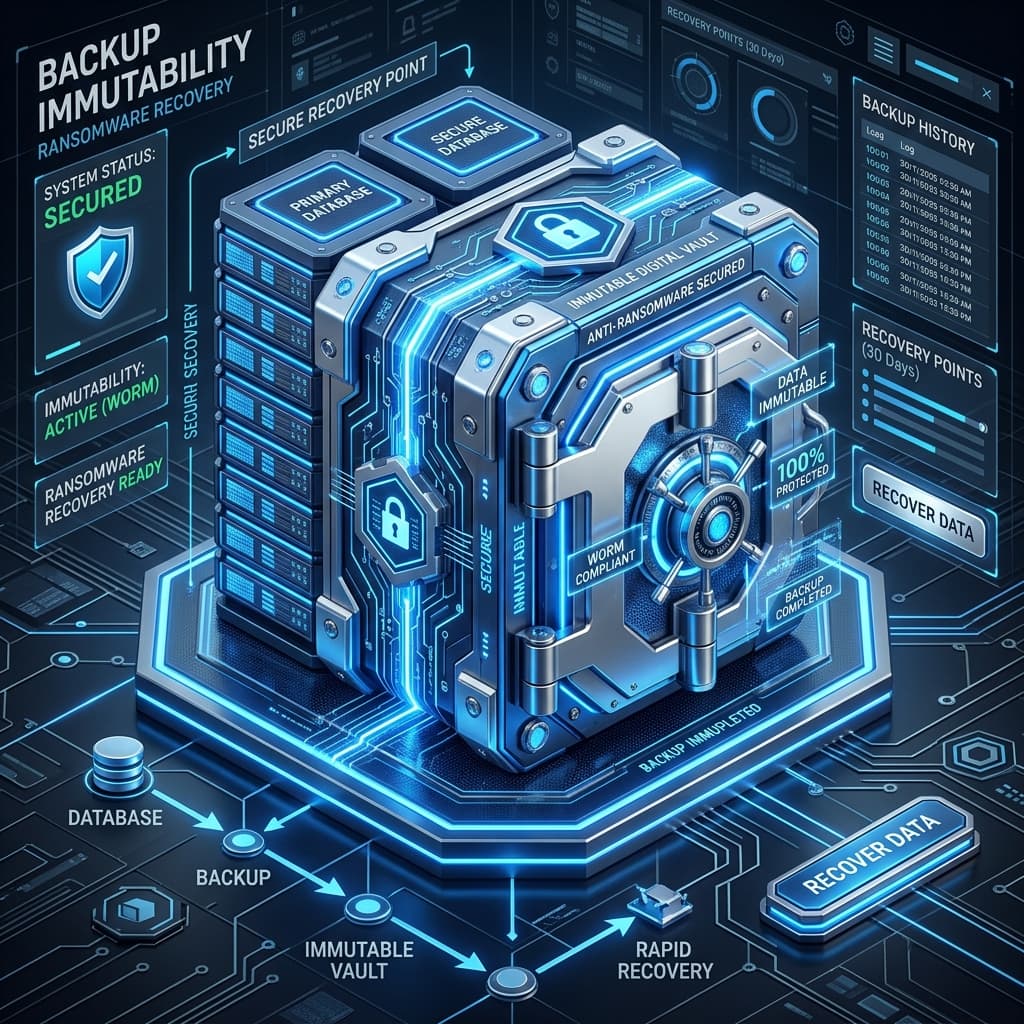
Mitigating this structural risk demands fierce segmentation of vault infrastructure. The backup administrative plane should operate on a fully isolated identity provider with decoupled directory domains and mandatory multifactor authentication using hardware security keys rather than SMS tokens. Organizations that rely on a shared identity fabric between production and backup systems create a single point of catastrophic failure. Segmentation is not a convenience; it is the architectural prerequisite for any immutability guarantee to hold under adversarial pressure.
We facilitate small-group sessions for customers and prospects without requiring a slide deck, focused on your stack, constraints, and the decisions you need to make next.
Critical destructive operations such as vault deletion or retention policy modification must require multiparty authorization. When one administrator initiates a bulk deletion request, the system should hold that action in escrow until a separate designated security officer independently approves it. This dual-control mechanism mirrors the principle behind nuclear launch protocols and provides a final procedural safeguard against both insider threats and compromised credentials that bypass purely technical controls.
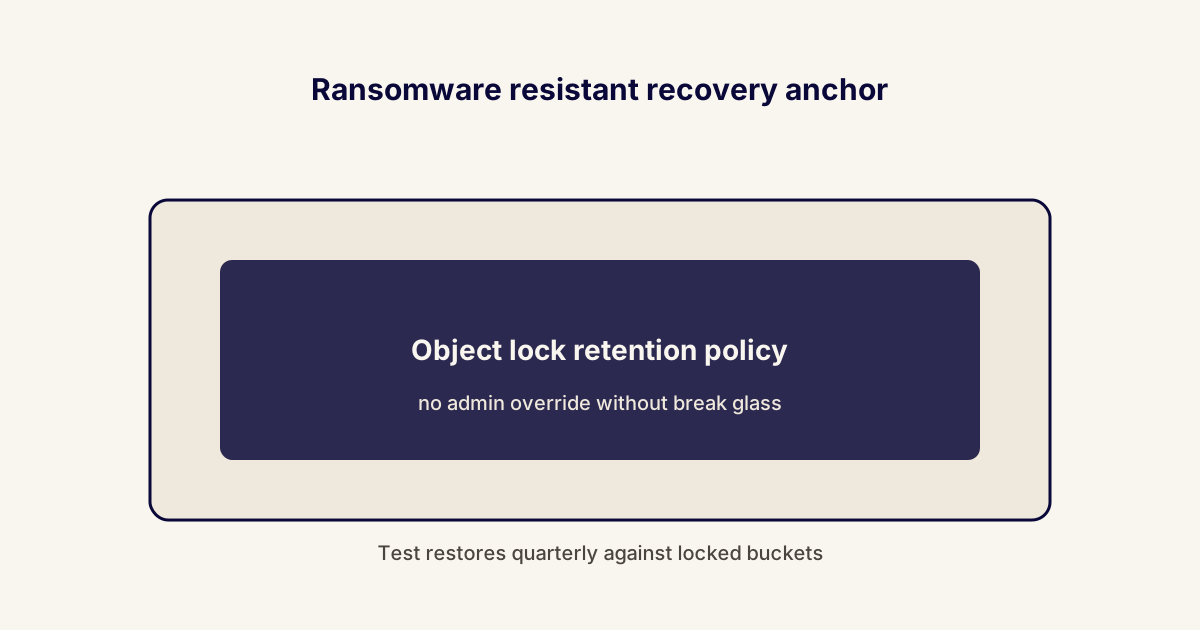
Cloud storage object lock policies require precise alignment between legal counsel and operational teams. Indefinite retention may appear to be the safest security posture, but it directly conflicts with privacy regulations. When frameworks like the European GDPR or the California CCPA mandate consumer data deletion upon verified request, immutable buckets that physically prevent alteration place the organization in immediate regulatory noncompliance. Resolving this tension requires carefully designed retention governance rather than blanket lock-everything policies.
Storage buckets must therefore be organized by data classification with granular retention policies tuned to each class. Critical system images and configuration snapshots may warrant a rigid three-year retention lock, while high-volume consumer analytics datasets might use a rolling seven-day window to balance recovery capability against deletion mandates. Documenting these retention decisions in a formal data governance register ensures that both security and compliance teams operate from a single authoritative source of policy truth.
A frequently overlooked distinction is the difference between application-consistent and crash-consistent backups. For complex transactional databases, a simple storage-level snapshot taken while the application is actively writing transaction logs may produce a corrupted, functionally useless image. Organizations must explicitly document which workloads require full application-consistent quiescence, including database freeze and flush operations, and which can tolerate basic crash-consistent snapshots. Failing to make this distinction turns a successful backup into a dangerously false sense of security.
Simulated recovery drills must move beyond full-datacenter restoration fantasies and evaluate realistic, partial-restore scenarios with surgical precision. Real ransomware events typically require targeted recovery rather than wholesale rebuilds. Incident response teams frequently need to recover exactly three corrupted database tables from a specific point twelve minutes before the suspected intrusion began, all without disrupting hundreds of healthy tables running on the same cluster. Drills that ignore this level of granularity provide organizational comfort but not operational competence.
Detailed tabletop exercises reveal missing or outdated runbook steps far more effectively than annual compliance audits. When engineering leadership designs an unpredictable, high-pressure mock scenario, the organization quickly discovers which key personnel lack proper administrative access, which decryption keys are missing from the secure repository, and how long a seemingly simple terabyte-scale restoration physically takes to traverse the network backbone. These findings must feed directly into remediation backlogs with assigned owners and firm deadlines.
Recovery Time Objectives and Recovery Point Objectives must be explicitly aligned with the assumptions embedded in cyber insurance policies. Insurers increasingly define their own technical expectations for how quickly an organization must recover critical systems and how much data loss is permissible before coverage provisions activate. If the stated RTO in an insurance application is four hours but actual tested recovery consistently takes sixteen, the resulting discrepancy can void coverage entirely. Aligning stated objectives with demonstrated capability is not optional.
The financial stakes surrounding backup resilience are extraordinarily high. Cyber insurance underwriters now demand verifiable, cryptographic proof of regularly tested immutable or offline copies. Insurers actively track the frequency and fidelity of full technical restoration drills, and they cross-reference these records against policy questionnaire responses during claims investigations. Failing to maintain continuous operational evidence of tested recovery capability will result in denied claims following a catastrophic breach, precisely when coverage matters most to organizational survival.
Organizations must also evaluate supply chain risks within the backup software stack itself. Backup agents and management consoles represent high-value targets for sophisticated attackers because compromising these tools provides direct access to every protected workload. Verifying software integrity through signed binaries, restricting update channels to validated sources, and monitoring backup agent behavior for anomalous activity are essential defensive steps. A compromised backup tool transforms the entire recovery architecture from a safety net into an attack vector.
Migrating to cloud-managed backup services shifts significant operational burden, but shared responsibility models make clear that configuration decisions ultimately define survival. A misconfigured S3 bucket policy or an overly permissive IAM role has historically caused catastrophic data deletions indistinguishable in impact from a targeted attack. Cloud providers supply the immutability tooling, but the organization retains full responsibility for configuring retention locks, access controls, and replication policies correctly, then continuously verifying their effectiveness through automated compliance checks.
Board-level governance of backup resilience is becoming a regulatory expectation rather than a best practice recommendation. Frameworks like the SEC cybersecurity disclosure rules and the EU Digital Operational Resilience Act require executive attestation that recovery capabilities have been tested and found adequate. CISOs should present quarterly metrics covering backup integrity verification rates, drill completion timelines, and gap remediation progress to the board. Governance without measurement is indistinguishable from negligence in the current regulatory climate.
Finally, comprehensive telemetry and monitoring must actively alert security operations teams to anomalous backup job failures, suspicious bulk deletion API calls, and unexpected retention policy modifications. These signals deserve the same investigative priority as active intrusion indicators rather than being silently queued in a backend ticketing system. Integrating backup telemetry into the enterprise SIEM platform ensures that early warning signs of backup manipulation trigger immediate investigation and containment protocols before recovery options are permanently eliminated.